Stack AI Review 2026
No-code platform for building AI workflows and agents in enterprise settings. Supports content automation, document processing, and LLM integrations.
Key takeaways
- Stack AI is a no-code/low-code platform purpose-built for enterprise AI agent deployment, with strong compliance credentials (HIPAA, SOC 2 Type II, GDPR, ISO 27001).
- Best suited for IT teams, operations leaders, and enterprise architects at mid-to-large organizations in regulated industries like healthcare, finance, and legal.
- Offers 100+ integrations, LLM-agnostic model selection, flexible deployment (cloud, VPC, on-premise), and a human-in-the-loop workflow feature that most competitors skip.
- Free tier available with 500 runs/month; enterprise pricing is custom and requires a demo conversation.
- Not the right fit for solo developers or small teams who want a lightweight, self-serve automation tool -- the platform is clearly built for organizational scale.
Stack AI is an enterprise AI workflow and agent builder developed by a team of PhDs, positioning itself squarely at the intersection of no-code accessibility and serious enterprise infrastructure. The core pitch is simple: take a business process that currently requires human time and turn it into a working AI agent, without writing code. That sounds like a lot of tools, but Stack AI's differentiation is in the depth of its enterprise controls -- compliance certifications, flexible deployment options, audit logs, and a governance layer that IT teams actually care about.
The company targets organizations with regulated or complex operations: think hospital systems that need HIPAA-compliant document processing, financial institutions running due diligence workflows, or legal teams reviewing contracts at scale. The customer testimonials on the site include SVPs of Operations, Chief Information Officers, and Chief Data Officers -- not individual contributors or startup founders. That tells you a lot about who this is really for.
Stack AI appears to have been founded by researchers with machine learning backgrounds (the footer notes "Made by PhDs at [MIT]"), and the product has matured into a platform that competes with tools like Microsoft Copilot Studio, Automation Anywhere, and n8n in the enterprise automation space. The company even has a direct comparison page against n8n on their site, which signals they're actively competing for the workflow automation buyer who might otherwise go the open-source route.
Key features
Drag-and-drop workflow builder
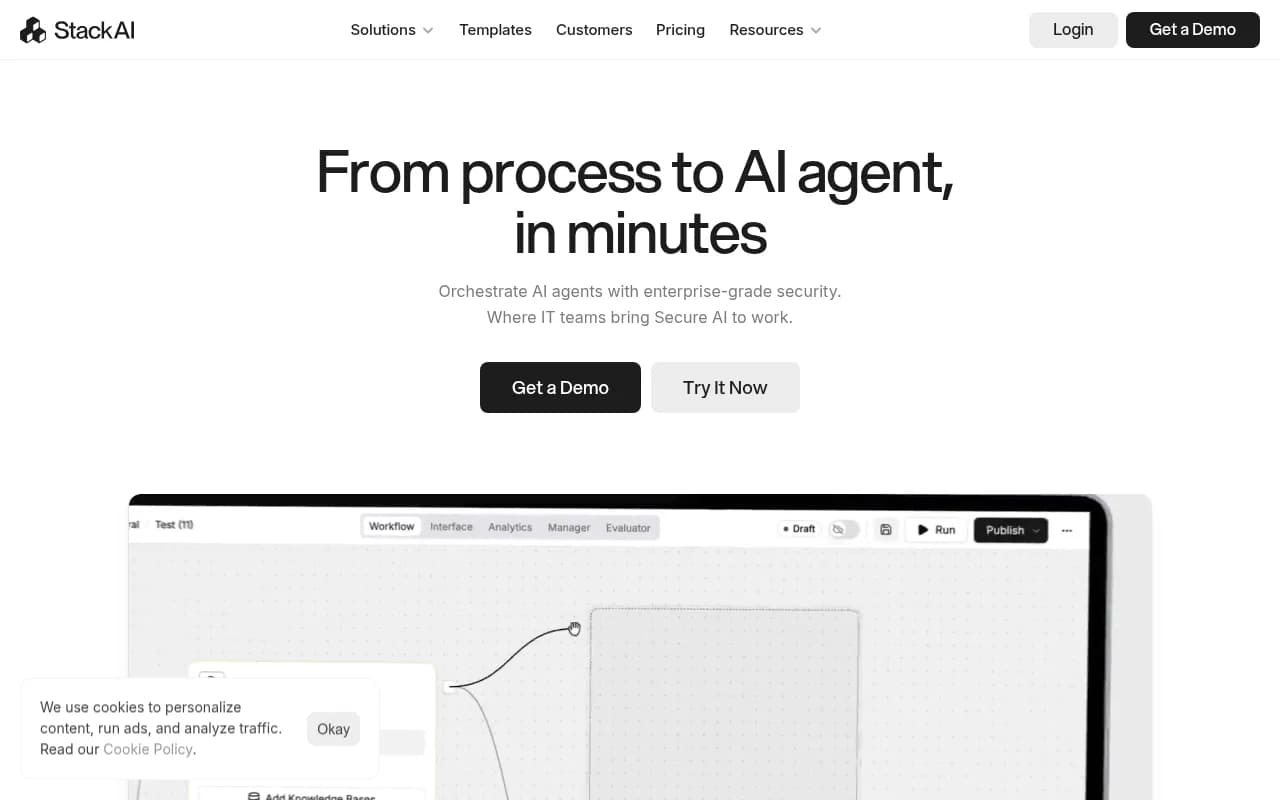
The core interface is a visual canvas where you connect nodes representing inputs, LLM calls, data sources, logic branches, and output actions. You can wire together a document upload node, an Anthropic Claude LLM node with a custom prompt, and an email action node in a few minutes. The builder supports conditional logic, loops, and parallel execution paths. In practice, this means non-technical users can build fairly sophisticated multi-step agents without touching code -- though complex branching logic can get visually cluttered in larger workflows.
LLM-agnostic model selection
Stack AI doesn't lock you into a single AI provider. You can deploy different models for different tasks within the same workflow -- use GPT-4o for complex reasoning, Claude Sonnet for document summarization, and a smaller open-source model for classification tasks where cost matters. This is genuinely useful for enterprise buyers who want to optimize cost and performance per task rather than committing to one vendor's entire model lineup. The platform supports OpenAI, Anthropic, Google (Gemini), Meta (Llama), Mistral, and others.
RAG (Retrieval-Augmented Generation) pipelines
Stack AI has built-in support for connecting agents to your own knowledge bases. You can upload documents, connect to SharePoint, Confluence, or other data sources, and have the agent retrieve relevant context before generating responses. This is the backbone of use cases like internal knowledge assistants, policy Q&A bots, and document review tools. The RAG implementation handles chunking, embedding, and retrieval -- you don't need to configure a separate vector database.
Human-in-the-loop controls
This is one of the more interesting features and one that separates Stack AI from simpler automation tools. You can insert human review checkpoints at any point in a workflow -- so an AI agent can draft a contract redline, but a human attorney must approve before it gets sent. Or an AI can triage an insurance claim, but a human adjuster reviews edge cases above a certain dollar threshold. This kind of controlled automation is exactly what regulated industries need, and most no-code AI tools don't handle it well.
Enterprise deployment options
Stack AI supports multi-tenant cloud, private VPC deployment, and on-premise installation. For organizations that can't send data to a shared cloud environment -- hospitals, defense contractors, financial institutions with strict data residency requirements -- this is a non-negotiable capability. Competitors like Zapier AI or Make don't offer this. The VPC and on-premise options are enterprise-tier features and require a custom contract.
Security and compliance certifications
The platform holds HIPAA, SOC 2 Type II, GDPR, and ISO 27001 certifications. This isn't just marketing -- these certifications require third-party audits and ongoing compliance work. For enterprise procurement teams, having these certifications in hand dramatically shortens the vendor evaluation process. Stack AI also offers BAA (Business Associate Agreement) signing for healthcare customers and publishes DPAs for both OpenAI and Anthropic integrations.
Agentic development lifecycle management
Beyond building individual workflows, Stack AI provides tooling for managing agents across their full lifecycle: versioning, testing environments, staging vs. production deployments, and monitoring. This matters when you're running dozens of agents across different departments. The platform includes an audit log feature so you can track what each agent did, when, and with what inputs -- important for compliance and debugging.
100+ enterprise integrations
The integration library covers the major enterprise software categories: CRM (Salesforce), productivity (Microsoft 365, Google Workspace), ITSM (ServiceNow, Jira), document management (SharePoint, Confluence, Box), databases, and communication tools (Slack, email). Agents can read from and write to these systems, not just query them. That bidirectional capability is what makes the difference between a chatbot that answers questions and an agent that actually completes tasks.
White-glove onboarding and support
Stack AI explicitly markets dedicated AI expert support as a feature. For enterprise buyers, this matters -- you're not just buying software, you're buying implementation help. The company runs bootcamps and has an Academy for training internal teams. This is a meaningful differentiator against self-serve tools where you're on your own after signup.
Who is it for
Stack AI is built for IT teams and enterprise architecture groups at mid-to-large organizations who have been tasked with "deploying AI" but don't want to build everything from scratch with Python and cloud infrastructure. Think a 500-person financial services firm where the CIO wants to automate loan document processing, or a hospital network where the operations team needs to build a HIPAA-compliant patient intake assistant without waiting 18 months for the engineering team to build it. The platform's sweet spot is organizations with real compliance requirements and real operational complexity -- not startups experimenting with AI.
The "citizen developer" use case is also real here. One customer testimonial mentions going "from a bottleneck of experts to a citizen developer movement" and tracking toward $1M in operational savings. That's the pattern Stack AI is optimized for: empowering business analysts, operations managers, and department leads to build their own AI tools without depending on a central IT team for every request. This works best in organizations that have already done some AI literacy training and have a governance framework in place.
Industries where Stack AI particularly fits: healthcare (HIPAA compliance, clinical document processing), financial services (due diligence, KYC, financial report summarization), legal (contract review, data room analysis), and enterprise IT (ticket triage, ITSM automation). The platform has dedicated solution pages for each of these verticals, which suggests real customer traction rather than aspirational positioning.
Who should not use Stack AI: solo developers or small startups who want a lightweight, self-serve tool. The platform's enterprise focus means the pricing, onboarding process, and feature set are calibrated for organizational buyers. If you're a freelancer building a simple AI chatbot for a client, tools like Voiceflow, Botpress, or even a direct API integration will be faster and cheaper. Similarly, if you're a developer who's comfortable with code, n8n or LangChain give you more flexibility at lower cost.
Integrations and ecosystem
Stack AI's integration catalog covers 100+ connections across enterprise software categories. Notable integrations include:
- Productivity and documents: Microsoft 365 (Word, Excel, SharePoint, Teams), Google Workspace (Drive, Docs, Sheets, Gmail), Confluence, Notion
- CRM and sales: Salesforce, HubSpot
- ITSM: ServiceNow, Jira, Zendesk
- Storage and databases: Box, Dropbox, AWS S3, PostgreSQL, MySQL
- Communication: Slack, email (SMTP/IMAP)
- LLM providers: OpenAI, Anthropic, Google Gemini, Meta Llama, Mistral, and others
The platform also has a REST API for custom integrations and webhook support for triggering workflows from external systems. Documentation is available at docs.stackai.com, and the company maintains an Academy for training resources.
There's a Discord community (discord.gg/sSbwawtNsV) and a YouTube channel for tutorials. The GitHub presence (github.com/stackai) appears to be primarily for community resources rather than an open-source codebase -- Stack AI is a proprietary platform.
No native mobile app was found, which is consistent with the enterprise IT buyer focus -- these workflows are typically built and managed from desktop environments.
Pricing and value
Stack AI offers a free tier with 500 runs per month, which is genuinely useful for evaluation and small-scale testing. Beyond that, the pricing structure moves to enterprise custom pricing, which requires a demo conversation with the sales team.
Based on available information:
- Free plan: 500 runs/month, limited integrations, suitable for proof-of-concept work
- Enterprise plans: Custom pricing based on usage volume, number of users, deployment type (cloud vs. VPC vs. on-premise), and support level
The lack of published pricing tiers is a common pattern for enterprise software and isn't surprising given the deployment flexibility and compliance requirements involved. It does mean you can't self-serve into a paid plan -- you need to talk to sales, which adds friction for smaller teams evaluating the tool.
Compared to alternatives: Microsoft Copilot Studio starts around $200/month for 25,000 messages, which is relatively accessible but locks you into the Microsoft ecosystem. n8n's cloud plans start at $20/month but require more technical setup and lack the enterprise compliance certifications. Automation Anywhere and UiPath are more expensive and more complex. Stack AI's pricing likely sits in the mid-to-upper range for enterprise AI platforms, but the compliance certifications and white-glove support justify the premium for regulated industries.
Strengths and limitations
What Stack AI does well:
- The compliance certification stack (HIPAA, SOC 2 Type II, GDPR, ISO 27001) is genuinely comprehensive and removes a major procurement obstacle for regulated industries. Most no-code AI tools don't have all four.
- The human-in-the-loop feature is thoughtfully implemented. Being able to insert human review checkpoints into automated workflows is exactly what risk-conscious enterprises need, and it's not a common feature in this category.
- LLM agnosticism is real and practical. Mixing models within a single workflow based on task requirements is a meaningful capability for cost and performance optimization.
- The deployment flexibility (cloud, VPC, on-premise) covers the full range of enterprise data residency requirements. This alone disqualifies most competitors for certain buyers.
- Customer testimonials from C-suite executives at named organizations (not anonymous) suggest genuine enterprise adoption rather than SMB users.
Honest limitations:
- Pricing opacity is a real friction point. Not publishing any pricing tiers means every evaluation requires a sales conversation, which slows down teams that want to self-evaluate before engaging with sales.
- The platform is clearly optimized for organizational buyers, which means solo developers or small teams will find it over-engineered and potentially over-priced for their needs. There are lighter-weight alternatives that are faster to get started with.
- Complex workflows can become visually unwieldy in the drag-and-drop canvas. This is a common limitation of visual workflow builders -- at a certain level of complexity, code is actually cleaner. Stack AI doesn't appear to offer a code-first alternative for power users who hit this ceiling.
- The free tier's 500 runs/month limit is quite restrictive for any meaningful production testing. You'll hit that ceiling quickly if you're running document processing workflows with real data volumes.
Bottom line
Stack AI is a serious enterprise platform for organizations that need to deploy AI agents at scale with real compliance requirements and governance controls. If you're an IT leader or enterprise architect at a healthcare, financial services, or legal organization, and you need to build AI workflows that can actually pass a security audit, Stack AI is one of the few no-code options that can credibly meet those requirements.
The best use case in one sentence: a regulated enterprise that wants to automate document-heavy processes (contract review, claims processing, financial analysis, IT ticket triage) using AI agents, without building custom infrastructure, and without compromising on compliance.
Frequently asked questions
What is Stack AI?
Is Stack AI free to use?
What compliance certifications does Stack AI have?
Can Stack AI be deployed on-premise or in a private VPC?
How does Stack AI compare to n8n or Zapier?
What LLMs does Stack AI support?
Similar and alternative tools to Stack AI