Key takeaways
- Surfer SEO is the best pick if content optimization is your main focus -- its NLP-based scoring and AI writing workflow are more capable than HubSpot's topic cluster approach.
- Semrush is the closest like-for-like replacement if you want an all-in-one platform with keyword research, site audits, backlinks, and now AI search tracking.
- Ahrefs wins on backlink data and technical depth; a strong choice for SEO-heavy teams who don't need a CRM attached to their tools.
- SE Ranking is the best value for agencies managing multiple clients -- solid features at a noticeably lower price than Semrush or Ahrefs.
- Clearscope is the cleanest content optimization tool for editorial teams who just want to write better content without learning a full SEO suite.
- Rankability is worth a look if you're an agency that wants SEO and AI search (AEO) tracking in one workflow.
- Promptwatch is the right call if AI search visibility -- not traditional Google SEO -- is where you need to grow. It goes beyond monitoring to actually help you create content that gets cited by ChatGPT, Claude, and Perplexity.
- Moz Pro and Mangools are solid budget-friendly options for smaller teams or solo practitioners who don't need enterprise-grade data.
HubSpot SEO is a perfectly decent tool if you're already deep in the HubSpot ecosystem. The topic cluster planner is genuinely useful, the Google Search Console integration works well, and having your SEO recommendations sitting next to your CRM and CMS is convenient. But "convenient" is doing a lot of heavy lifting there.
The honest reality is that HubSpot's SEO features are built for HubSpot users first, and SEO practitioners second. Keyword data is limited compared to dedicated tools. There's no backlink analysis to speak of. Site audit capabilities are basic. And if you're not hosting on HubSpot CMS, the value drops further. The pricing also gets uncomfortable fast -- the Professional plan at $890/month bundles a lot of marketing features you may not need just to access better SEO functionality.
So if you've outgrown HubSpot SEO, or you're evaluating it and wondering if there's something better suited to your actual workflow, here are the alternatives worth considering.
The alternatives
Surfer SEO
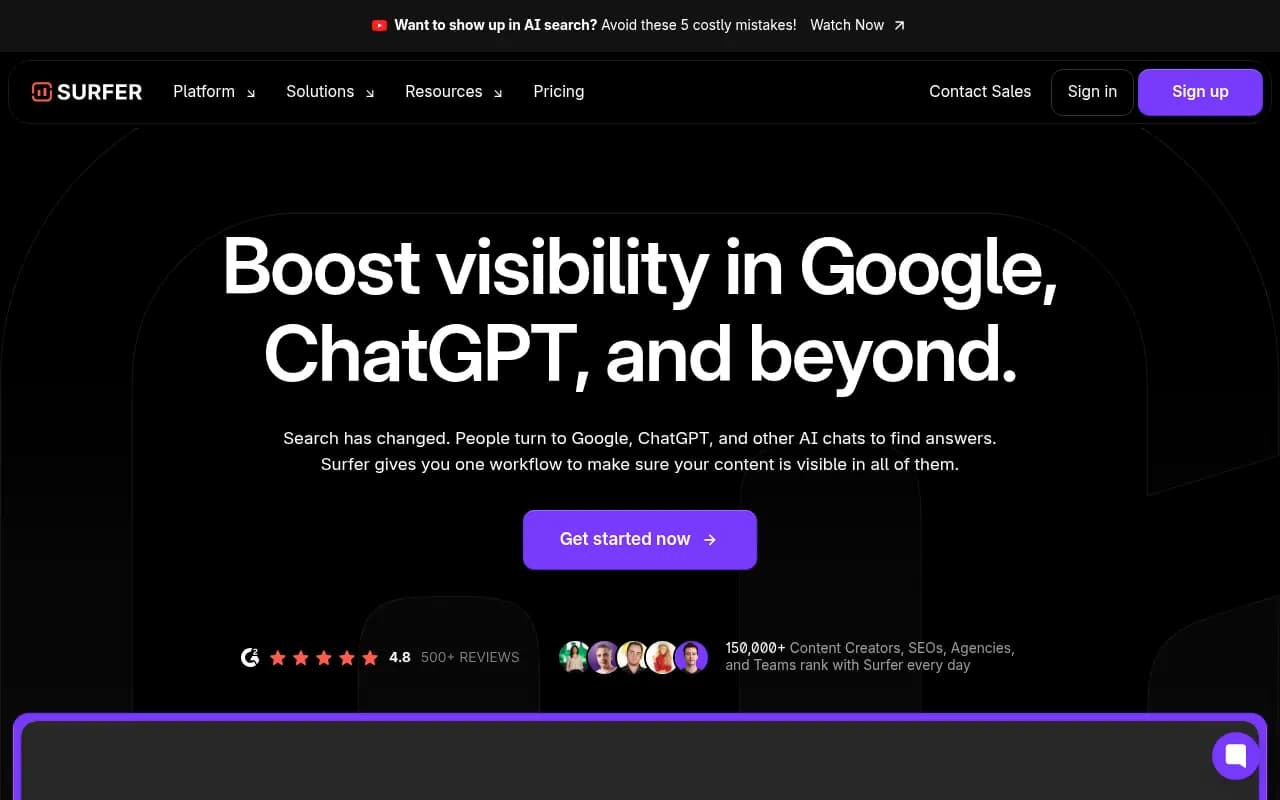
Surfer is probably the most direct alternative if content optimization is your core use case. Where HubSpot gives you topic cluster suggestions and basic keyword data, Surfer goes much deeper into what actually makes a page rank.
The Content Editor is the main draw. You paste in your draft (or write directly in Surfer), and it scores your content in real time based on NLP analysis of the top-ranking pages for your target keyword. It tells you which terms to include, how long the content should be, how many headings to use, and where you're falling short. It's not perfect -- sometimes the recommendations feel mechanical -- but it's genuinely useful for writers who want data to back up their decisions.
Surfer has also moved into AI search territory. The platform now tracks visibility across Google, ChatGPT, Perplexity, and Gemini, which puts it in a different category than it was a year ago. Whether that AI tracking is as deep as dedicated GEO platforms is debatable, but it's a meaningful addition.
Where Surfer falls short compared to HubSpot: there's no CRM integration, no email marketing, no all-in-one platform play. It's a focused tool. That's a feature for some teams and a limitation for others.
Pricing starts at $99/month (Essential), up to $299/month (Max), with enterprise pricing available. Surfer AI articles cost additional credits on top of the base plan, which can add up if you're generating a lot of content.
Best for: Content teams and SEO writers who want data-driven optimization and are comfortable using a standalone tool outside their CMS.
Semrush
Semrush is the most obvious HubSpot SEO replacement for teams that want a proper all-in-one platform. It covers keyword research, site audits, backlink analysis, rank tracking, content optimization, PPC research, social media, and now AI search visibility -- all under one roof.
The keyword database is enormous (over 26 billion keywords), and the competitive research tools are genuinely excellent. If you want to understand what your competitors are ranking for, where their traffic comes from, and which pages are driving their growth, Semrush is one of the best tools for that.
The AI search features are newer and still maturing. Semrush's AI Visibility Toolkit tracks brand mentions across ChatGPT, Perplexity, and Gemini, but the prompts are fixed rather than customizable, and there's no AI traffic attribution to connect visibility to actual revenue. It's a monitoring layer, not an optimization system.
Compared to HubSpot SEO, Semrush is significantly more powerful on every traditional SEO dimension. The trade-off is that it's not integrated with your CRM or CMS the way HubSpot is, and the interface has a learning curve. It's also more expensive at the higher tiers -- $580/month for the Advanced plan.
Best for: Marketing teams and SEO professionals who need comprehensive traditional SEO capabilities and are willing to pay for a best-in-class data platform.
Promptwatch

Promptwatch belongs in a slightly different category from the other tools here. It's not a traditional SEO platform -- it's built specifically for AI search visibility, which is increasingly where the real growth opportunity is.
If your concern is "why isn't my brand showing up when people ask ChatGPT for recommendations in my category?" -- that's exactly what Promptwatch is built to answer. It monitors how your brand appears across 10 AI models (ChatGPT, Claude, Perplexity, Gemini, Grok, DeepSeek, Copilot, Meta AI, Mistral, and Google AI Overviews), tracks which prompts your competitors are visible for that you're not, and then -- this is the part most tools skip -- helps you actually fix it.
The Answer Gap Analysis shows you the specific prompts where competitors are getting cited and you're not. The built-in content agent then generates articles, listicles, and comparisons grounded in real citation data (over 880 million citations analyzed) to close those gaps. You can track whether the new content actually gets cited, and connect that visibility to traffic via a code snippet, GSC integration, or server log analysis.
Other features worth knowing about: AI crawler logs that show when ChatGPT, Claude, and Perplexity are crawling your pages (and what errors they hit), Reddit and YouTube insights that surface discussions influencing AI recommendations, ChatGPT Shopping tracking, and prompt volume and difficulty scoring so you can prioritize the right opportunities.
Compared to HubSpot SEO, Promptwatch is solving a different problem entirely. HubSpot helps you rank in Google. Promptwatch helps you get cited in AI answers. For many brands in 2026, the second problem is the more urgent one.
Pricing starts at $99/month (Essential), $249/month (Professional), and $579/month (Business). Free trial available.
Best for: Brands and agencies that want to grow visibility in AI search engines -- not just track it, but actually improve it with content that gets cited.
Rankability
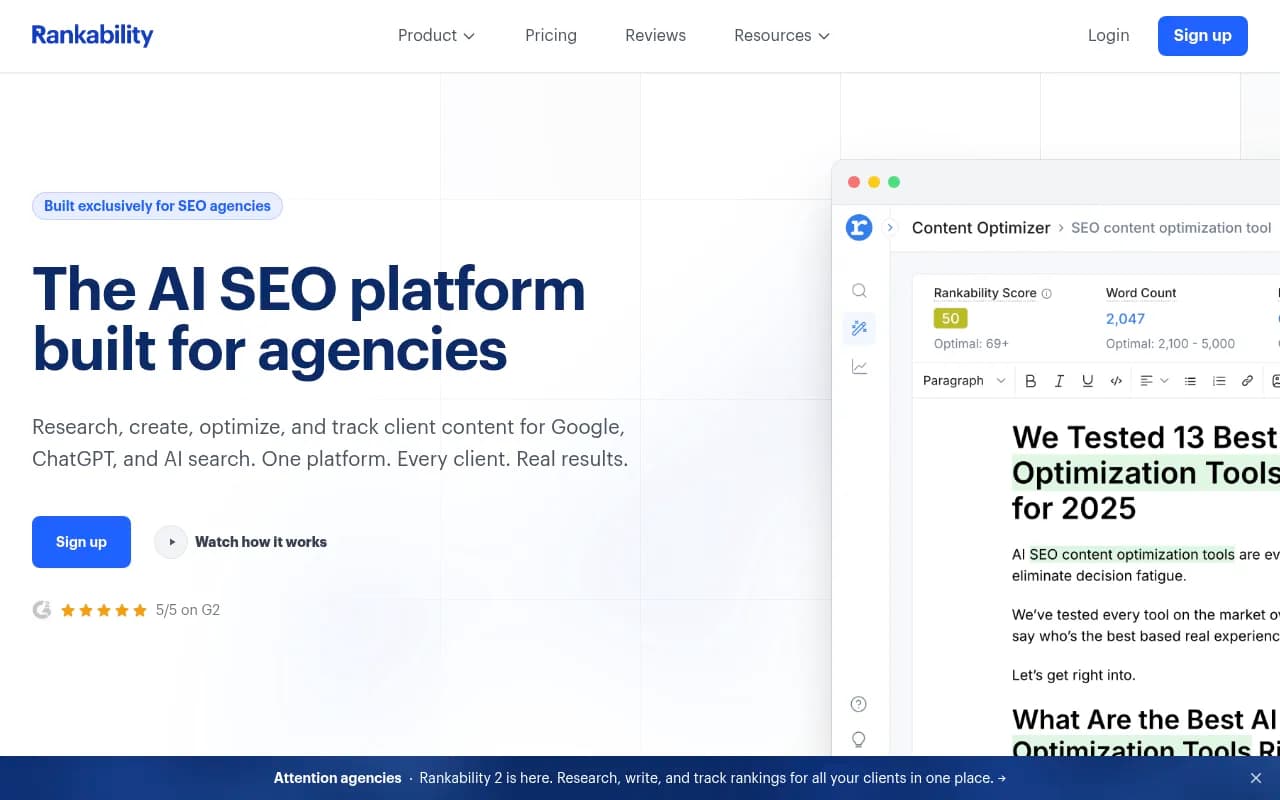
Rankability is a newer platform that's worth attention, especially for agencies. It combines keyword research, NLP-based content optimization, content briefs, and AI answer tracking (for ChatGPT, Gemini, and Perplexity) in one connected workflow.
The agency-focused design is the main differentiator. Multi-client management, team collaboration, and structured workflows are built in from the start rather than bolted on. The platform calls its approach "SEO + AEO" (Answer Engine Optimization), and it's one of the few tools that explicitly tries to serve both Google rankings and AI search visibility in a single system.
The content optimization side uses an SPI (Search Performance Index) score to grade your content against competitors, similar to Surfer's approach. The AI tracking side monitors when your clients' content gets cited in AI responses.
Compared to HubSpot SEO, Rankability is more capable on both content optimization and AI search tracking. It lacks HubSpot's CRM integration and broader marketing platform, but for agencies that don't need that, it's a cleaner fit.
Pricing starts at $149/month (SEO Specialist) up to $449/month (SEO Master). Free trial available.
Best for: Digital agencies managing multiple clients who want a unified SEO and AI search workflow without juggling separate tools.
SE Ranking
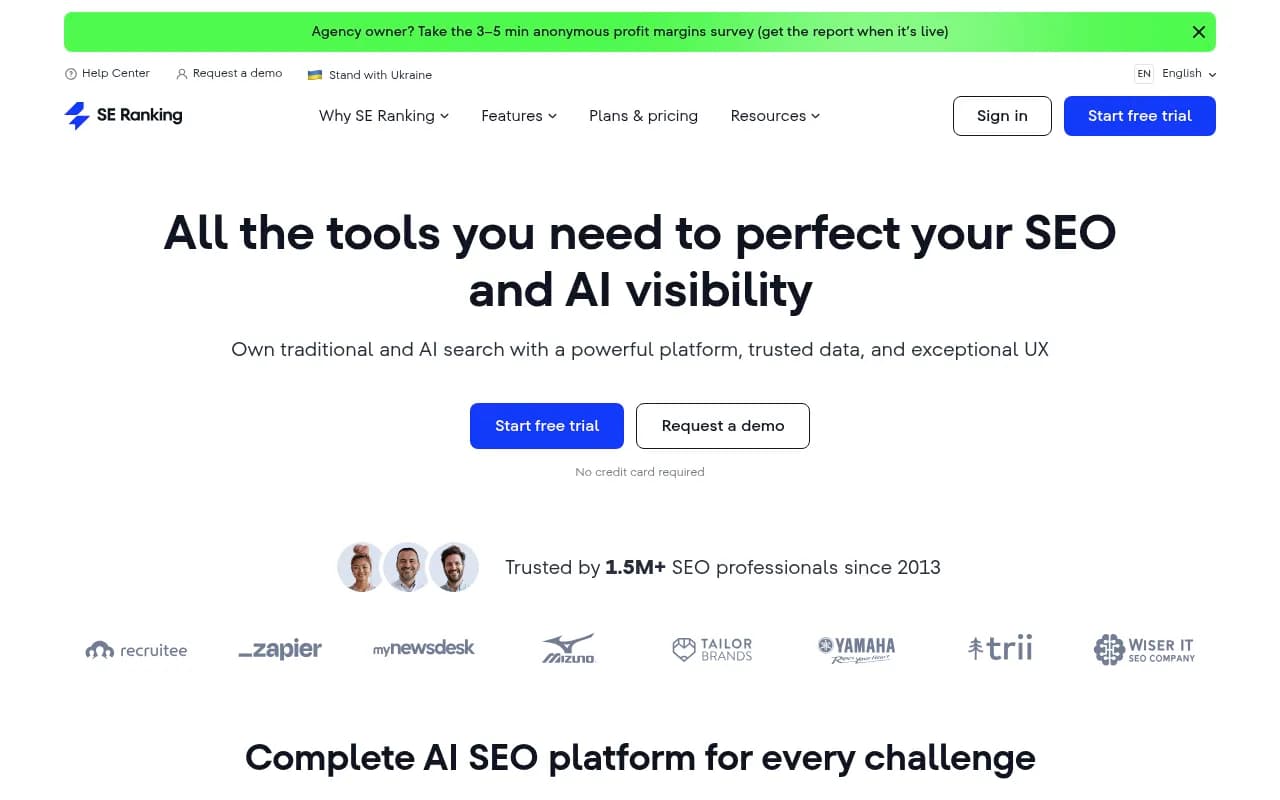
SE Ranking has been around since 2013 and has quietly built one of the more complete SEO platforms at a price point well below Semrush and Ahrefs. It covers rank tracking, keyword research, site audits, backlink monitoring, content optimization, and white-label reporting -- everything an agency or in-house team needs for traditional SEO.
The rank tracker is particularly strong, covering 188 countries with daily updates and local tracking down to city level. The keyword database has 5.4 billion keywords. The site audit tool catches technical issues reliably. And the white-label reporting is genuinely useful for agencies that need to send client reports without the SE Ranking branding.
AI search tracking is available as an add-on ($71.20/month on top of the base plan), which lets you monitor brand visibility across AI platforms. It's a monitoring layer rather than an optimization system, but it covers the basics.
Compared to HubSpot SEO, SE Ranking is more capable across every traditional SEO dimension and significantly cheaper than HubSpot Professional for teams that don't need the full marketing suite. The main thing you lose is the CRM/CMS integration.
Pricing starts at $103.20/month (Core, annual billing). The 14-day free trial requires no credit card.
Best for: Agencies and mid-sized teams that want comprehensive SEO capabilities at a reasonable price, with optional AI search monitoring.
Clearscope

Clearscope is the cleanest, most focused content optimization tool in this list. It does one thing -- helps you write content that ranks -- and it does it well.
The core workflow is simple: enter a keyword, get a content report showing the terms and topics you should cover, write or paste your content, and watch your grade improve as you incorporate the recommendations. The grading system is intuitive, and the reports are genuinely useful for writers who aren't SEO experts.
Clearscope has added AI search tracking, showing you how your content appears in ChatGPT and Gemini responses. It's not as deep as dedicated GEO platforms, but it gives editorial teams a basic picture of their AI visibility alongside their Google performance.
What Clearscope doesn't do: keyword research at scale, backlink analysis, site audits, rank tracking, or anything outside the content optimization lane. It's a specialist tool, not a platform.
Compared to HubSpot SEO, Clearscope is better at the actual content optimization job but covers far less ground overall. It's also more expensive for what you get -- $189/month for the Essentials plan, with no free trial (though demos are available).
Best for: Content teams and editorial operations that want the best content grading tool and don't need a full SEO suite.
Ahrefs
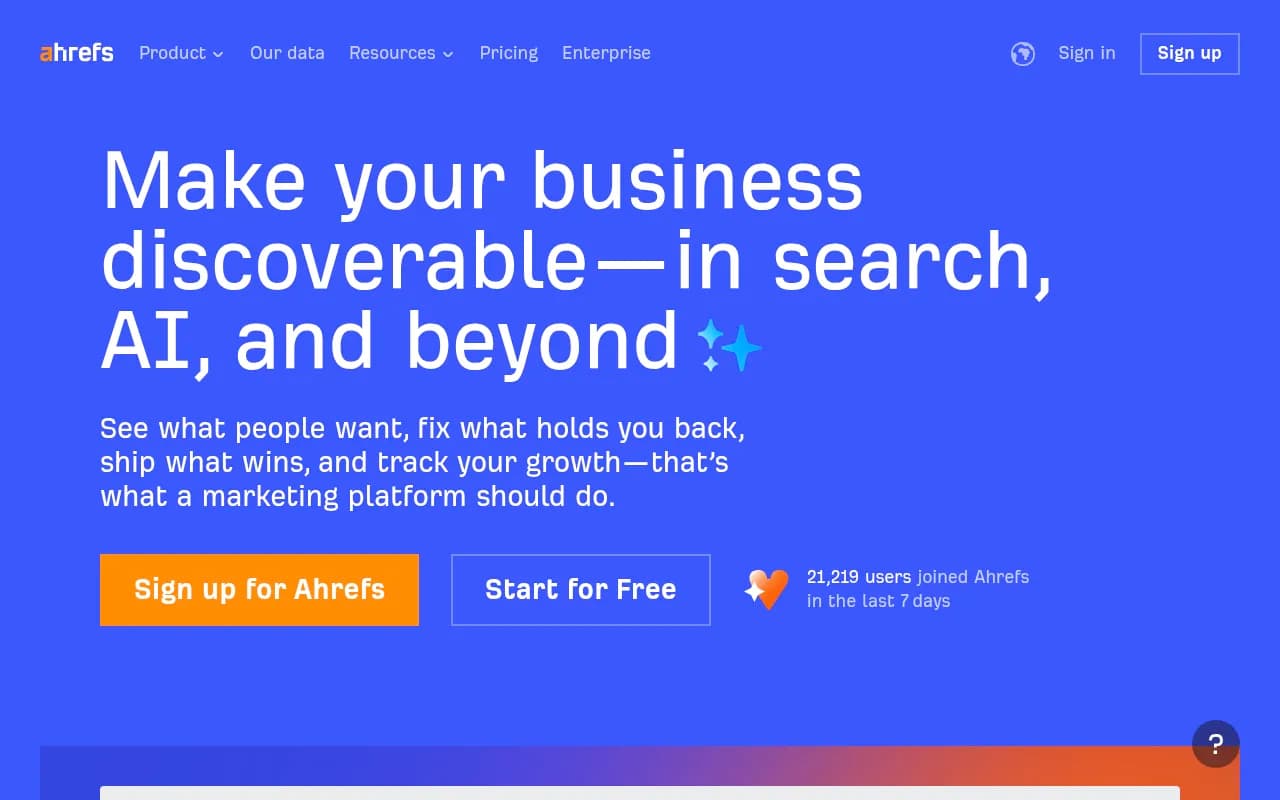
Ahrefs has the best backlink index in the industry, and that's not a close call. If link building, backlink analysis, or understanding your site's authority profile is important to your SEO work, Ahrefs is the tool most SEO professionals reach for first.
Beyond backlinks, Ahrefs covers keyword research, site audits, rank tracking, content gap analysis, and competitive research. The Site Explorer is particularly powerful for understanding what's driving a competitor's traffic. The Keywords Explorer has one of the largest keyword databases available.
The AI search side is handled through Brand Radar, which monitors brand mentions across AI platforms. Like Semrush's AI features, it's monitoring-focused with fixed prompts rather than customizable tracking, and there's no AI traffic attribution.
Compared to HubSpot SEO, Ahrefs is in a completely different league for technical SEO and backlink work. It's not integrated with a CRM or CMS, and the interface assumes some SEO knowledge. Pricing starts at $83/month (Lite), though the Starter plan at $29/month is quite limited.
Best for: SEO professionals and technical teams who prioritize backlink analysis, competitive research, and deep keyword data.
Moz Pro
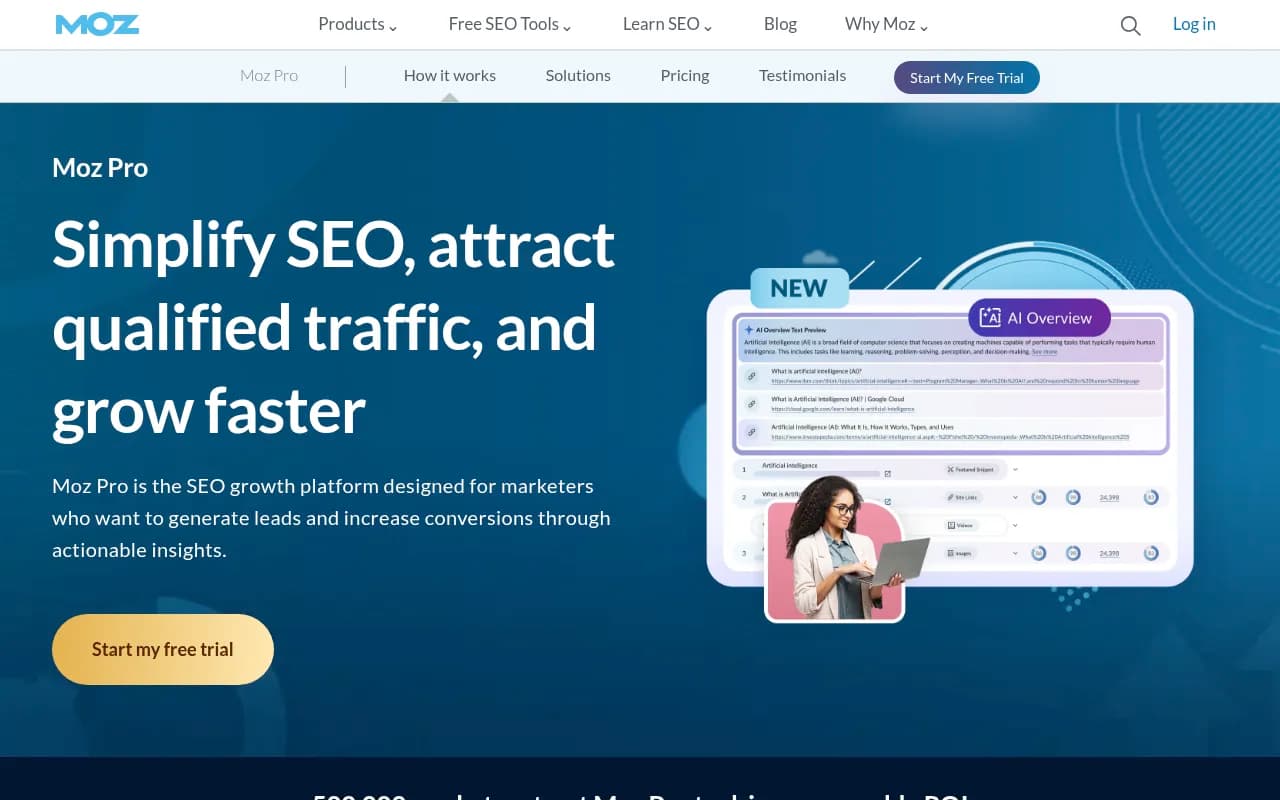
Moz Pro is one of the oldest names in SEO software, and it still holds up reasonably well for teams that don't need the cutting edge. The Keyword Explorer is solid, the On-Page Grader gives actionable content recommendations, and the site audit tool catches most common technical issues.
Moz's proprietary metrics -- Domain Authority and Page Authority -- are widely recognized, which makes Moz useful for reporting to stakeholders who are familiar with those numbers. The link opportunity discovery features are genuinely useful for link building campaigns.
Moz has added AI search monitoring (brand presence and LLM insights) to Moz Pro, tracking how often your brand appears in AI-generated answers. It's a basic monitoring layer, not an optimization system.
The honest trade-off with Moz: it's not as data-rich as Semrush or Ahrefs, and it's been slower to add new features. But it's also cheaper, with plans starting at $49/month (currently $39/month with promotions), and the 30-day free trial is one of the more generous in the category.
Compared to HubSpot SEO, Moz Pro is more capable for traditional SEO work and doesn't require you to be on HubSpot's platform. It's a reasonable mid-tier option.
Best for: Small to mid-sized teams that want a reliable, established SEO platform without paying Semrush or Ahrefs prices.
Mangools
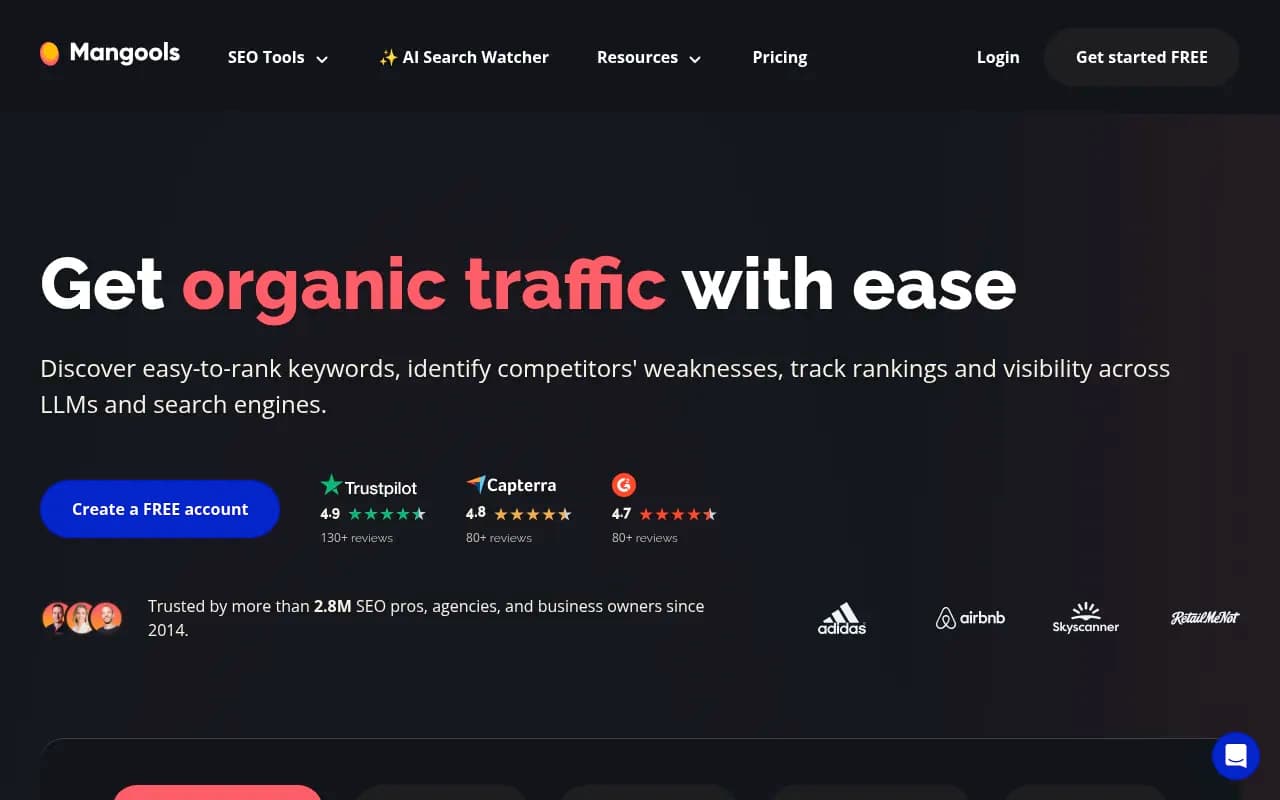
Mangools is the budget option that punches above its weight. For $29/month (annual billing), you get KWFinder for keyword research, SERPChecker for SERP analysis, SERPWatcher for rank tracking, LinkMiner for backlink research, and SiteProfiler for domain analysis.
The interface is genuinely one of the cleanest in the SEO tools space. Everything is designed to be approachable, which makes Mangools a good fit for freelancers, small business owners, and people who are newer to SEO and don't want to be overwhelmed by data.
Mangools has also added an AI Search Watcher tool that tracks brand visibility in AI platforms, and a free AI Search Grader. These are basic compared to dedicated GEO platforms, but they're included at a price point where most competitors don't offer anything.
The limitations are real: the keyword database is smaller than Semrush or Ahrefs, the site audit tool is basic, and there's no content optimization workflow. But for the price, it's hard to argue with.
Compared to HubSpot SEO, Mangools is cheaper and more capable for traditional SEO tasks, but it won't integrate with your CRM or CMS.
Best for: Freelancers, small business owners, and SEO beginners who want solid core tools at an accessible price.
Which tool should you pick?
The right answer depends on what you're actually trying to do.
If you're leaving HubSpot SEO because you want better traditional SEO capabilities -- keyword research, backlinks, site audits, rank tracking -- Semrush or Ahrefs are the obvious choices. Semrush is broader; Ahrefs is deeper on backlinks and technical analysis. SE Ranking is the right call if you want similar capabilities at a lower price, especially for agencies.
If content optimization is the specific gap, Surfer SEO or Clearscope will serve you better than HubSpot's topic cluster tools. Surfer has a more complete workflow; Clearscope has a cleaner interface.
If you're an agency managing multiple clients and want SEO and AI search tracking in one system, Rankability is worth evaluating seriously.
If budget is the primary constraint, Mangools at $29/month or Moz Pro at $49/month cover the basics without a large commitment.
And if your real concern is AI search visibility -- why your brand isn't showing up in ChatGPT or Perplexity responses, and what to do about it -- that's a different problem from traditional SEO, and it needs a different tool. Promptwatch is built specifically for that: monitoring where you're invisible, identifying the content gaps, generating content that gets cited, and tracking whether it works. Most of the tools in this list can show you data about AI search; Promptwatch is one of the few that helps you act on it.