Key takeaways
- Keyword Insights is a solid, focused tool for keyword clustering and content briefs -- but it doesn't do much beyond that. If you need rank tracking, site audits, or AI search monitoring, you'll need to look elsewhere.
- Surfer SEO is the closest direct competitor: it clusters, briefs, and writes, but it's pricier and now pitching itself as an AI visibility platform too.
- Frase is the best budget alternative for teams that want research + writing in one place, starting at $39/mo.
- MarketMuse goes deeper on topical authority modeling but costs significantly more -- better suited to larger content teams.
- Ahrefs and Semrush are full-suite SEO platforms that include keyword clustering as one feature among dozens; they make sense if you need everything under one roof.
- If you care about AI search visibility specifically (ChatGPT, Perplexity, Gemini citations), Promptwatch is the dedicated platform for that -- it goes beyond monitoring to actually help you create content that gets cited.
Keyword Insights has built a loyal following among SEO teams who want to move fast on content strategy. The core promise is simple: paste in a list of keywords, and the tool clusters them into topic groups, maps them to search intent, and generates content briefs. For teams drowning in keyword exports from Ahrefs or Semrush, that's genuinely useful.
But people start looking for alternatives for a few common reasons. Some find the pay-as-you-go pricing unpredictable once they're running large keyword sets regularly. Others want a tool that does more than clustering -- they want the writing, the rank tracking, or the AI search monitoring all in one place. And some teams simply outgrow the brief-generation quality and want something with deeper competitive analysis baked in.
Here's an honest look at what's actually out there.
The alternatives
Surfer SEO
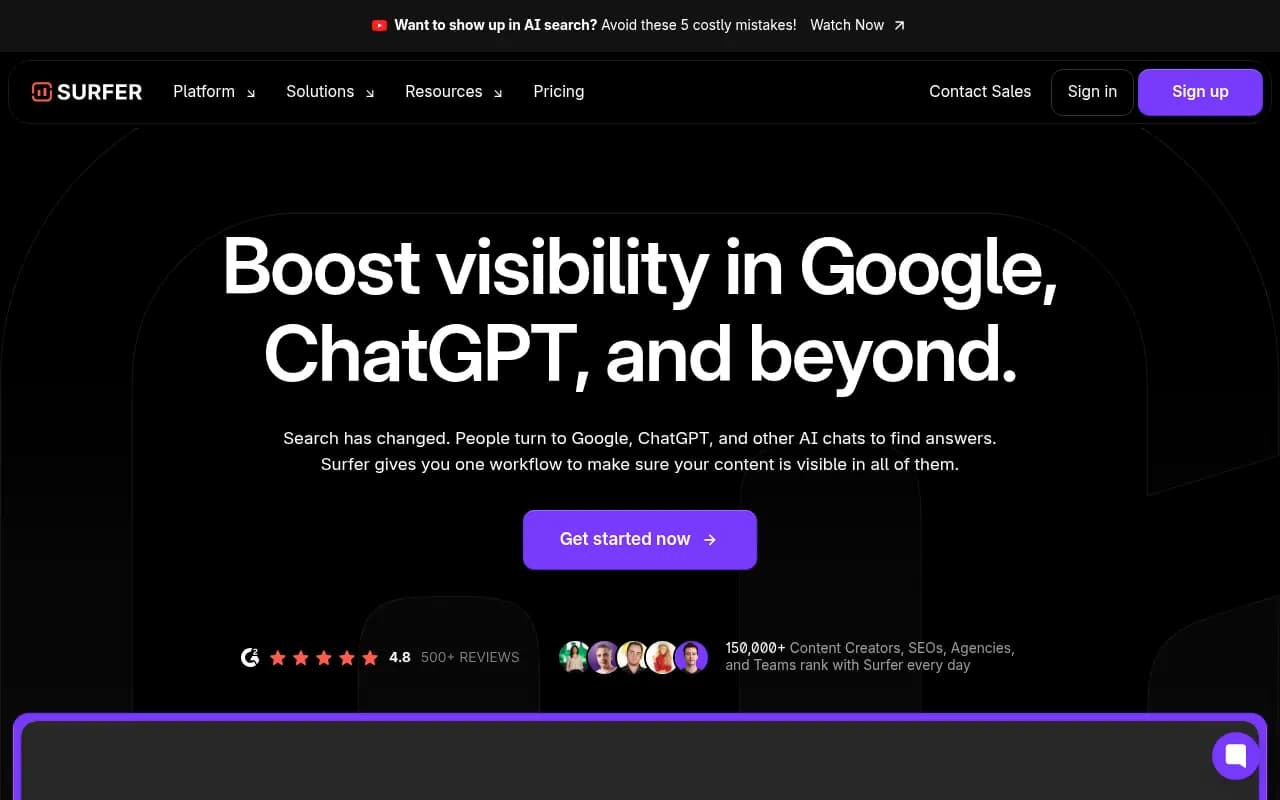
Surfer is probably the most direct comparison to Keyword Insights, and it's been expanding aggressively. Where Keyword Insights focuses on clustering and briefs, Surfer adds a content editor with real-time NLP scoring, an AI writing tool (Surfer AI), and -- more recently -- AI search tracking across ChatGPT, Perplexity, and Gemini.
The content editor is genuinely good. You paste in a target keyword, and Surfer pulls the top-ranking pages, extracts the terms they use, and gives you a score as you write. It's not just keyword density counting -- it's looking at semantic relevance, heading structure, and content length. Writers who use it regularly tend to produce more thorough content, which does tend to rank better.
Where Surfer falls short compared to Keyword Insights: the clustering workflow isn't as clean. Keyword Insights was built around clustering first; Surfer added it later. If you're processing thousands of keywords at once and need clean cluster exports, Keyword Insights still has an edge there.
Pricing is also a step up. Surfer starts at $99/mo (billed annually) for the Essential plan, which covers 30 articles per month. The AI writing credits cost extra on top of that. For teams that were on Keyword Insights' lower tiers, this is a meaningful jump.
Best for: Content teams that want clustering, brief generation, and content optimization in one tool, and don't mind paying more for the integrated writing experience.
Semrush
Semrush is a different category of tool entirely -- it's a full digital marketing platform that happens to include keyword clustering as one of its many features. The Keyword Manager tool lets you group keywords by topic, and the Content Marketing Toolkit handles briefs and optimization. But you're buying a lot more than that: backlink analysis, site audits, PPC research, social media tools, competitive intelligence, and now an AI Visibility Toolkit.
The AI search features are worth mentioning. Semrush has added monitoring for ChatGPT, Perplexity, and Gemini, so you can see how your brand appears in AI-generated responses. It's useful, but the implementation uses fixed prompts rather than letting you define your own -- which limits how actionable the data is.
The honest trade-off: Semrush is expensive and complex. The entry price is $165/mo, and the features most comparable to Keyword Insights (content briefs, keyword clustering) are spread across multiple toolkits that can feel disconnected. If you're already a Semrush user, the clustering tools are worth exploring. If you're not, it's a big commitment just to replace Keyword Insights.
Best for: Teams that already use Semrush for SEO and want to consolidate their content planning into the same platform, rather than paying for a separate clustering tool.
Promptwatch

Promptwatch is a different kind of tool -- it's not a keyword clustering platform, so if that's all you need, this isn't the right fit. But if you're thinking about where content strategy is heading, it's worth understanding what it does.
The core problem Promptwatch solves: your content might rank in Google but be invisible in ChatGPT, Claude, Perplexity, and other AI search engines. Those platforms are now where a meaningful chunk of discovery happens, and most SEO tools don't help you understand or improve that visibility.
Promptwatch tracks your brand's presence across 10 AI models, shows you which prompts competitors appear for that you don't, and then -- this is the part that separates it from monitoring-only tools -- has a built-in content agent that generates articles and comparisons grounded in real citation data. The idea is to close the loop: find the gap, create the content, watch the citations improve.
It also has AI crawler logs, which show you when ChatGPT or Perplexity's crawlers are hitting your site and what they're reading. That's genuinely hard to get elsewhere.
Pricing starts at $99/mo for the Essential plan (1 site, 50 prompts, 5 articles/mo), with Professional at $249/mo and Business at $579/mo.
Best for: Marketing and SEO teams who want to understand and improve their visibility in AI search engines -- particularly if they're already doing keyword clustering elsewhere and want to layer in AI search optimization.
SE Ranking
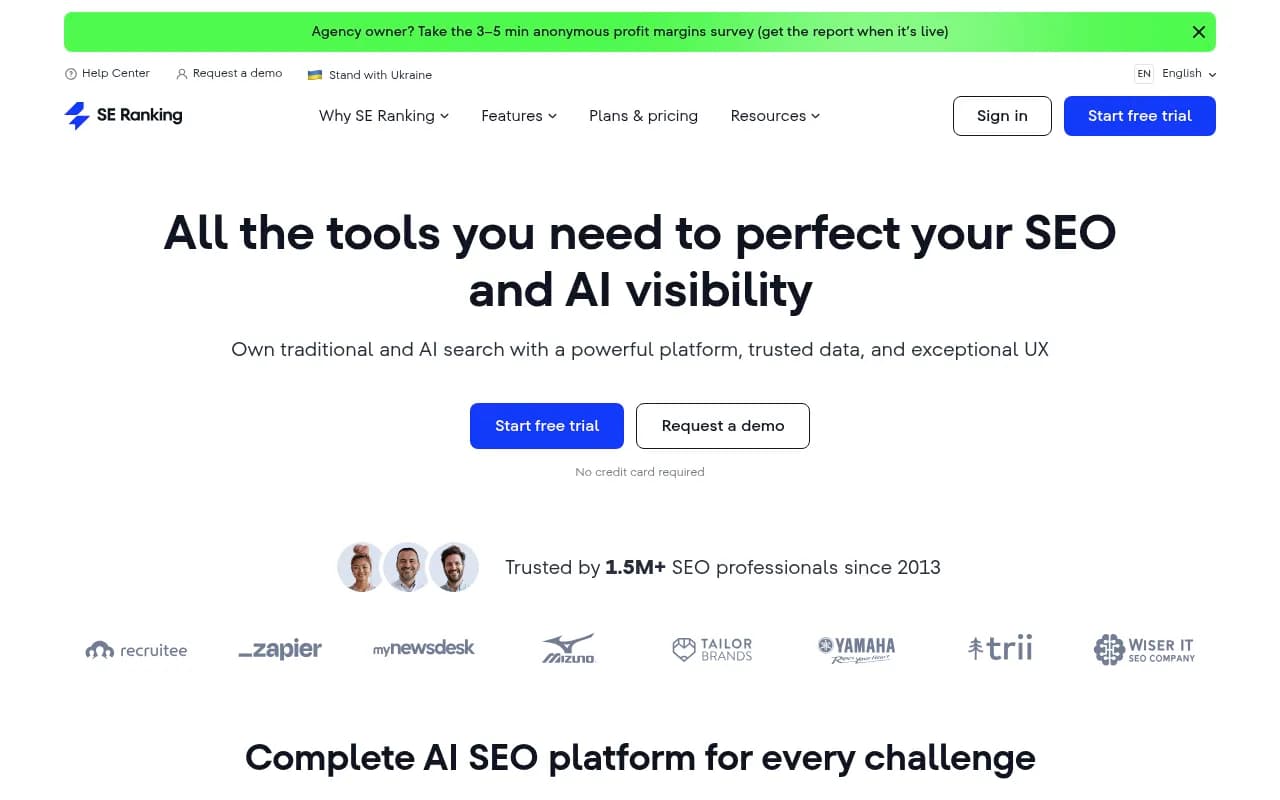
SE Ranking is a well-rounded SEO platform that's been around since 2013 and has steadily added features without the price inflation that's hit some competitors. It covers rank tracking, site audits, keyword research, backlink monitoring, and content optimization -- plus a newer AI Search add-on that monitors visibility in AI-generated responses.
The content tools include a brief generator and an AI writing assistant, which puts it in similar territory to Keyword Insights for content planning. The keyword clustering isn't as sophisticated -- SE Ranking groups keywords by SERP similarity, which works but doesn't give you the same depth of intent mapping that Keyword Insights provides.
Where SE Ranking wins: it's a genuinely complete SEO platform at a price that doesn't feel punishing. The Core plan starts at $103.20/mo (annual billing), and the 14-day free trial requires no credit card. For agencies managing multiple clients, the white-label reporting is a real differentiator.
The AI Search add-on is $71.20/mo on top of the base plan, which adds up -- but if you want traditional SEO plus some AI visibility monitoring in one place, it's a reasonable bundle.
Best for: Small to mid-size agencies and in-house SEO teams that want a full SEO platform with decent content tools, and don't need the depth of clustering that Keyword Insights specializes in.
Frase
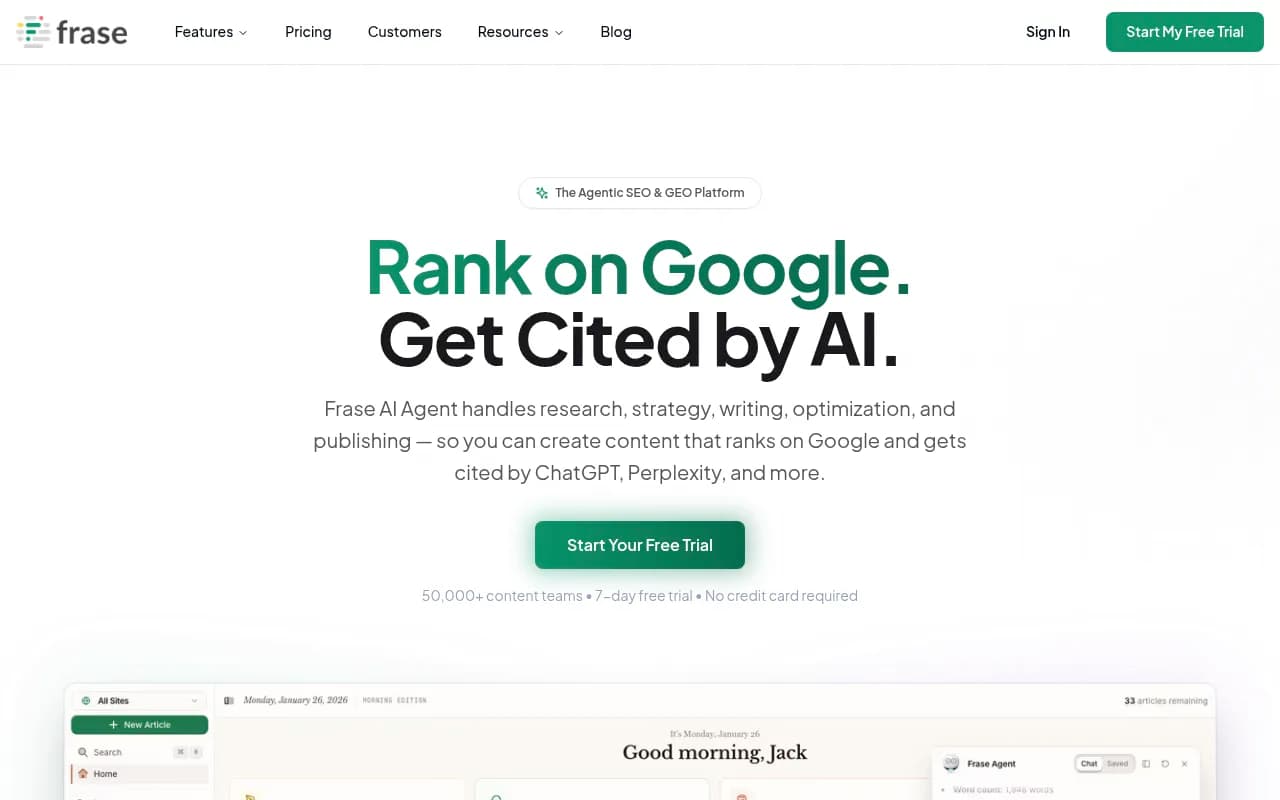
Frase has positioned itself as an "agentic SEO and GEO platform" -- which is a lot of words for what it actually does well: research a topic, generate a content brief, write a draft, and score it against competitors. The workflow is fast and the interface is clean.
For teams that find Keyword Insights useful but wish it would just write the article too, Frase is the natural next step. You enter a keyword, Frase pulls the top 10 SERP results, identifies content gaps, and generates a brief with an outline. The AI writing is decent -- not exceptional, but good enough to get a first draft you can edit.
Frase has also added a GEO Score feature that tracks visibility in ChatGPT and Perplexity, which is a newer addition and still maturing compared to dedicated AI visibility platforms. It's useful for a directional read but not as granular as purpose-built tools.
Pricing is genuinely competitive: $39/mo for Starter (4 articles/mo), $103/mo for Professional (unlimited articles), $239/mo for Scale. The 7-day free trial doesn't require a credit card.
The main limitation: Frase's keyword clustering is basic. It's not designed to process thousands of keywords and group them -- it's designed to help you write one piece of content at a time. If bulk clustering is your primary use case, Frase won't replace Keyword Insights.
Best for: Content writers and small teams who want research, briefing, and writing in one affordable tool, and don't need to process large keyword sets in bulk.
MarketMuse
MarketMuse takes a different philosophical approach to content strategy. Rather than starting with a keyword list, it starts with your existing content inventory and asks: where do you already have authority, and where are the gaps? The AI analyzes your site, identifies topic clusters you're strong in, and surfaces opportunities where you can win with relatively little effort.
The "personalized difficulty" scoring is genuinely useful -- it tells you how hard a topic is to rank for specifically given your site's existing authority, not just a generic competition score. That's more actionable than what most tools provide.
The trade-off is price. MarketMuse's free plan is very limited, and the Standard plan starts around $149/mo. The Premium and Enterprise tiers -- where the full power of the platform lives -- run into the thousands per month. For a small team or solo SEO, that's hard to justify.
Compared to Keyword Insights, MarketMuse is less about processing raw keyword lists and more about strategic content planning at a site level. They're solving adjacent problems, and which one you need depends on where you are in your content strategy maturity.
Best for: Established content teams at mid-to-large companies who want to optimize their existing content inventory and build topical authority systematically, and have the budget to support it.
Clearscope

Clearscope is the tool that content teams tend to love and finance teams tend to wince at. It does one thing exceptionally well: content optimization. You give it a keyword, it analyzes the top-ranking pages, and it gives you a grade (A+ to F) based on how well your content covers the relevant terms and topics. The grading system is intuitive enough that writers actually use it without needing SEO training.
Clearscope has been expanding into AI search monitoring -- it now tracks visibility in ChatGPT and Gemini and shows you which sources LLMs are pulling from. It's a useful addition, though it's still primarily a content optimization tool rather than a full AI visibility platform.
The keyword clustering in Clearscope is limited. It has a "Topic Explorations" feature for discovering related topics, but it's not designed for bulk keyword processing. If you're coming from Keyword Insights specifically for the clustering workflow, Clearscope won't fill that gap.
Pricing starts at $189/mo for the Essentials plan -- higher than most alternatives here. There's no free trial, though demos are available.
Best for: Content teams where writer adoption is a priority and the content editor experience matters more than bulk keyword processing. Works well alongside a separate keyword research tool.
Ahrefs
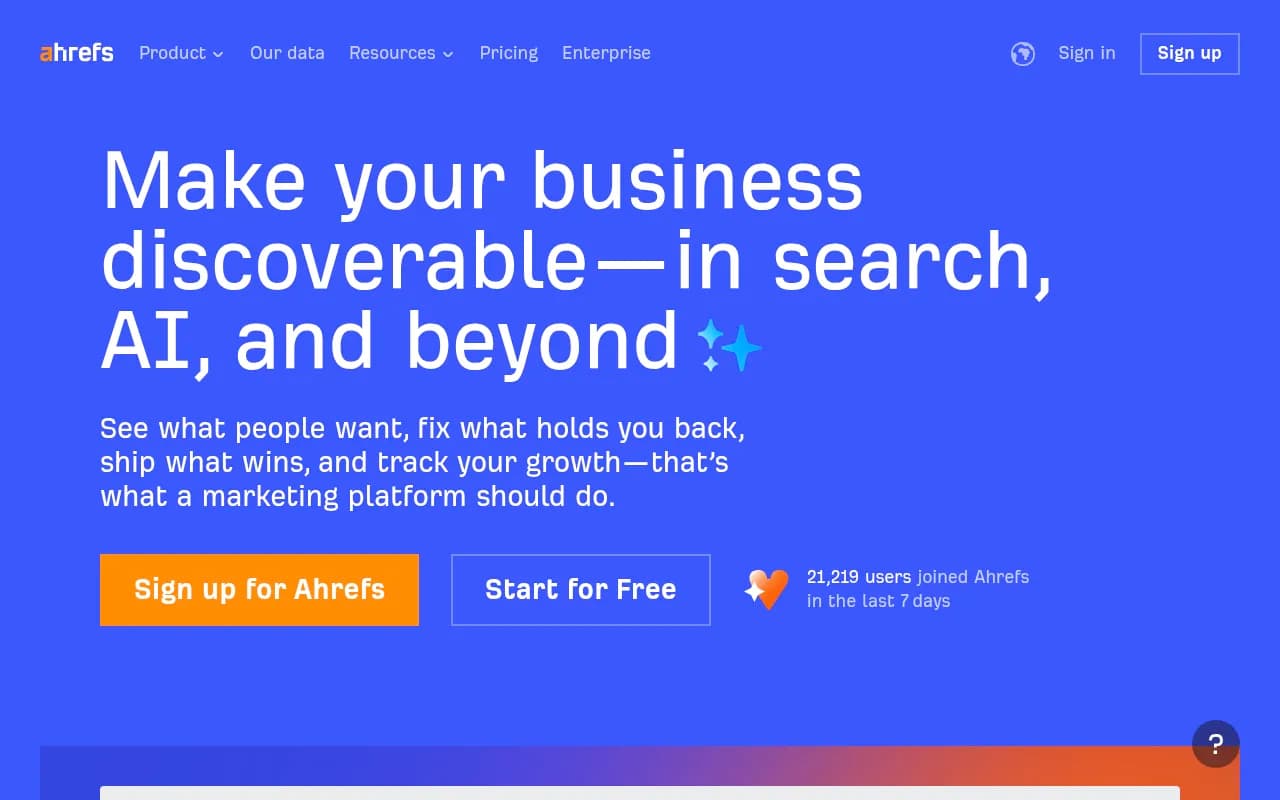
Ahrefs is one of the two dominant full-suite SEO platforms (alongside Semrush), and it's been adding AI search features through its Brand Radar tool. The core platform is excellent for keyword research, backlink analysis, site audits, and rank tracking -- it's genuinely best-in-class for several of those functions.
The keyword clustering in Ahrefs is handled through the Keywords Explorer, which groups keywords by parent topic and shows SERP overlap. It's functional but not as purpose-built as Keyword Insights -- you're not getting the same level of intent mapping or brief generation.
The AI search monitoring through Brand Radar is worth noting: it tracks brand mentions across AI platforms, but uses fixed prompts rather than custom ones, and doesn't include AI traffic attribution. For teams that want to understand their AI search presence more deeply, that's a limitation.
Pricing starts at $83/mo for the Lite plan (annual billing), though the Standard plan at $166/mo is where most serious SEO teams land. The Starter plan at $29/mo is very restricted.
Best for: SEO teams that need a comprehensive platform for traditional SEO and want keyword clustering as one feature among many, rather than a dedicated clustering tool.
Frase vs. Ubersuggest: the budget end of the market
Ubersuggest
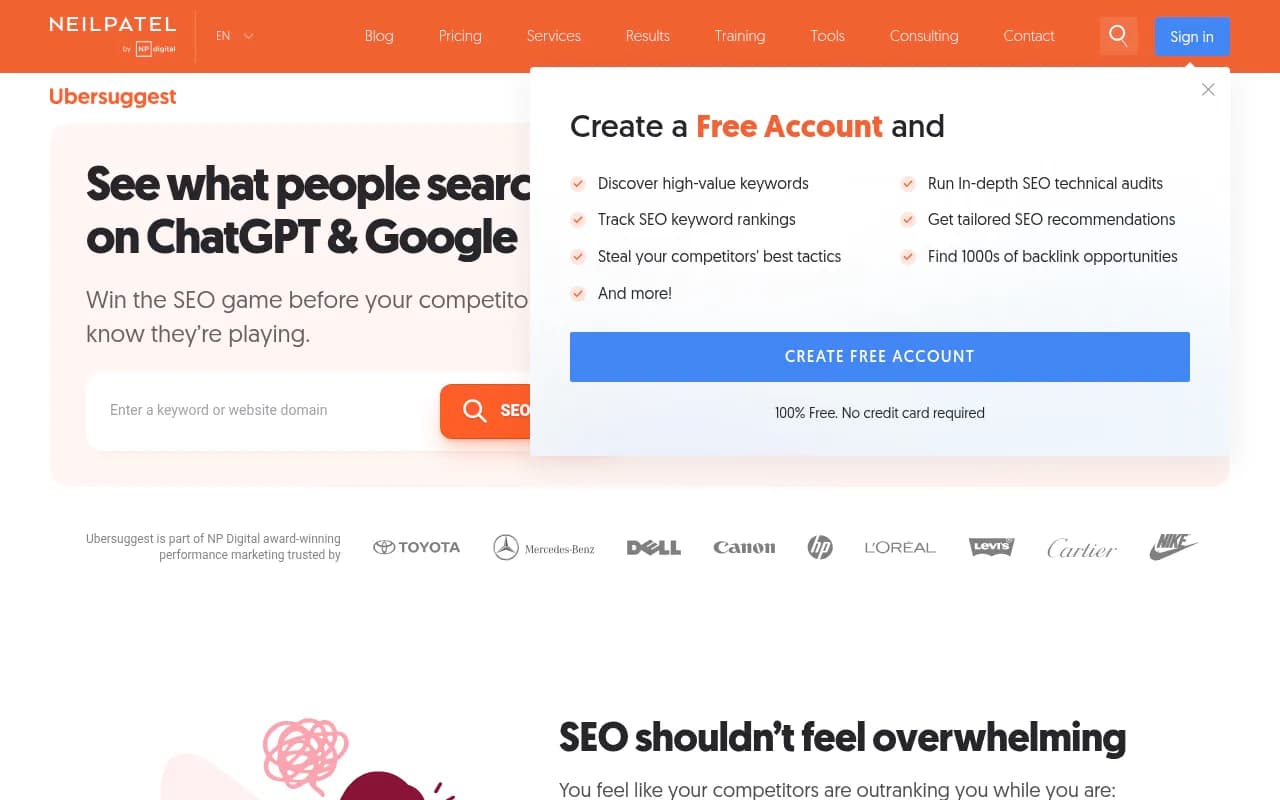
Ubersuggest is the entry-level option here, and it's worth being honest about what that means. It's a solid keyword research tool with a clean interface, decent search volume data, and basic competitor analysis. The lifetime pricing ($290 one-time for the Individual plan) is genuinely attractive for freelancers and small businesses who don't want recurring subscriptions.
What it doesn't do: keyword clustering, content briefs, or anything resembling the workflow that Keyword Insights is built around. It's a keyword research tool, not a content planning platform. If you're looking for a Keyword Insights alternative because you want more features, Ubersuggest is a step backward. If you're looking for something cheaper and simpler for basic keyword research, it's worth considering.
Best for: Freelancers, bloggers, and small business owners who need basic keyword data without a complex workflow or a recurring subscription.
KeywordsPeopleUse
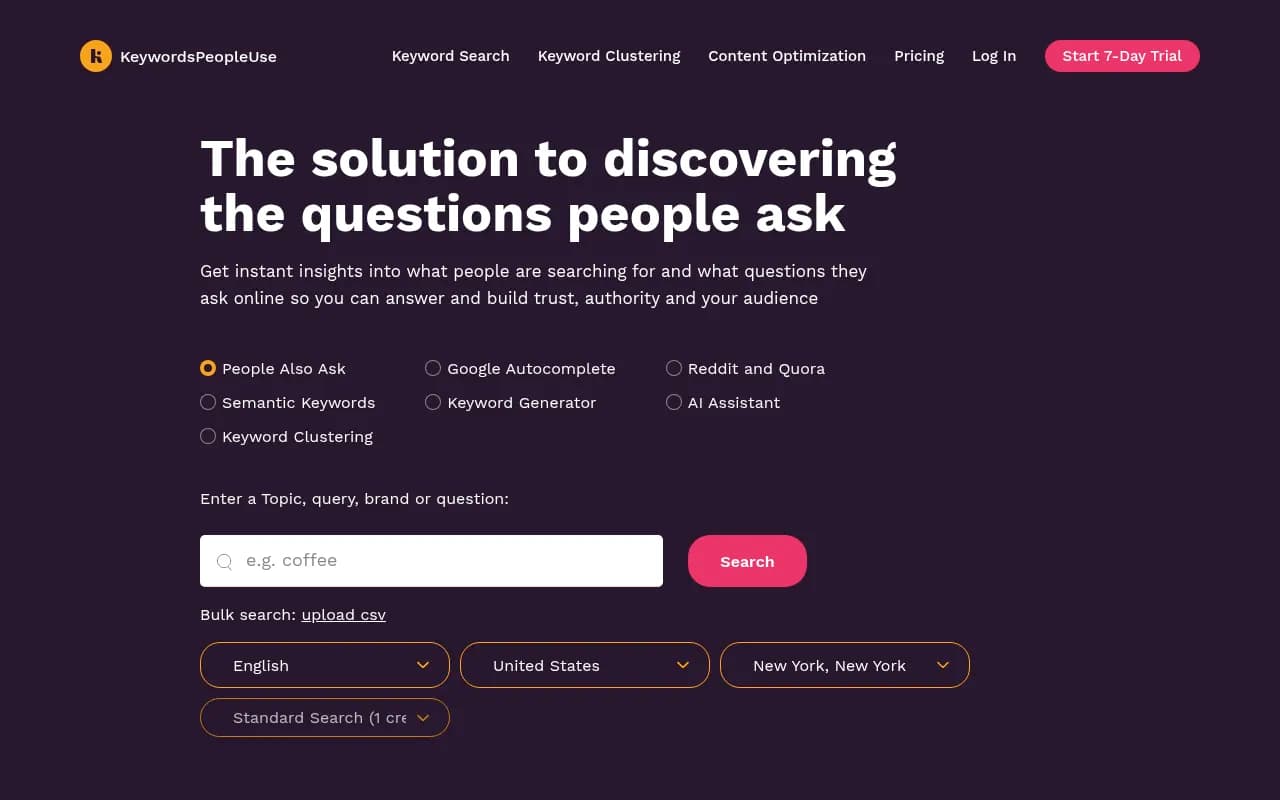
KeywordsPeopleUse is a niche tool that does something specific very well: it mines People Also Ask results, Google autocomplete, Reddit, and Quora to surface the actual questions people are asking about a topic. The output is question-based keyword data that's genuinely useful for content planning, FAQ sections, and understanding user intent.
It's not a clustering tool in the Keyword Insights sense -- it doesn't take a list of keywords and group them by topic. It's more of a question-discovery tool that complements keyword research. The pricing is accessible ($15-55/mo depending on the plan), and the 7-day free trial makes it easy to test.
Where it gets interesting: the Reddit and Quora data is useful for understanding what real people are asking in communities, which is increasingly relevant as AI models pull from these sources when generating responses.
Best for: Content teams that want to understand user intent at a granular level and build content around real questions, used alongside a primary keyword research or clustering tool.
How to choose
The right alternative depends on what's actually missing from your Keyword Insights workflow:
If you want better content writing alongside clustering, Frase ($39/mo) is the most affordable upgrade, and Surfer SEO ($99/mo) is the more polished option.
If you want a full SEO platform and can absorb the cost, Ahrefs or Semrush give you everything -- keyword clustering, rank tracking, site audits, backlinks -- though neither is as focused on clustering as Keyword Insights.
If topical authority modeling and content strategy at a site level is the goal, MarketMuse is the most sophisticated option, but the price reflects that.
If AI search visibility is the gap you're trying to fill -- understanding how ChatGPT, Perplexity, and Gemini are citing your content -- that's a different problem from keyword clustering, and a dedicated platform like Promptwatch is built specifically for it.
Keyword Insights is genuinely good at what it does. Most teams looking for alternatives aren't leaving because it's bad -- they're leaving because their needs have grown beyond clustering and briefs. The question is which direction they've grown in.