Key takeaways
- If you want a content optimization tool that scores your writing against top-ranking pages, Surfer SEO ($99/mo) is the most direct MEGA SEO alternative for content teams.
- For a full traditional SEO suite with the deepest data, Ahrefs or Semrush are the go-to options -- both are significantly more expensive but cover backlinks, PPC, and competitive intelligence far beyond what MEGA SEO does.
- SE Ranking is a strong mid-market pick for agencies that need white-label reporting and solid rank tracking without Semrush's price tag.
- Frase and Clearscope are narrower content-focused tools -- good if you want research and optimization without the full autopilot approach.
- If your concern is AI search visibility (ChatGPT, Perplexity, Gemini), none of the above cover it well. Promptwatch is the dedicated platform for that, with content gap analysis and AI-specific content generation built in.
- Screaming Frog and Ubersuggest are worth knowing about for specific use cases: technical audits and budget keyword research, respectively.
MEGA SEO pitches itself as an "autopilot" marketing platform -- you hand over your SEO, and AI agents handle strategy, content creation, technical fixes, and reporting. The appeal is obvious: it's cheaper than an agency and requires less hands-on work than traditional SEO tools. Starting at $299/month, it targets businesses that want results without building an in-house SEO team.
But autopilot isn't for everyone. Some teams want more control over their content. Others need deeper data than MEGA SEO provides. Some are already invested in a tool like Ahrefs and just need to fill gaps. And a growing number of marketers are realizing that traditional SEO tools -- even the best ones -- don't tell you anything about how your brand appears in ChatGPT or Perplexity.
Whatever your reason for looking, here are the best alternatives to MEGA SEO in 2026.
The alternatives
Surfer SEO
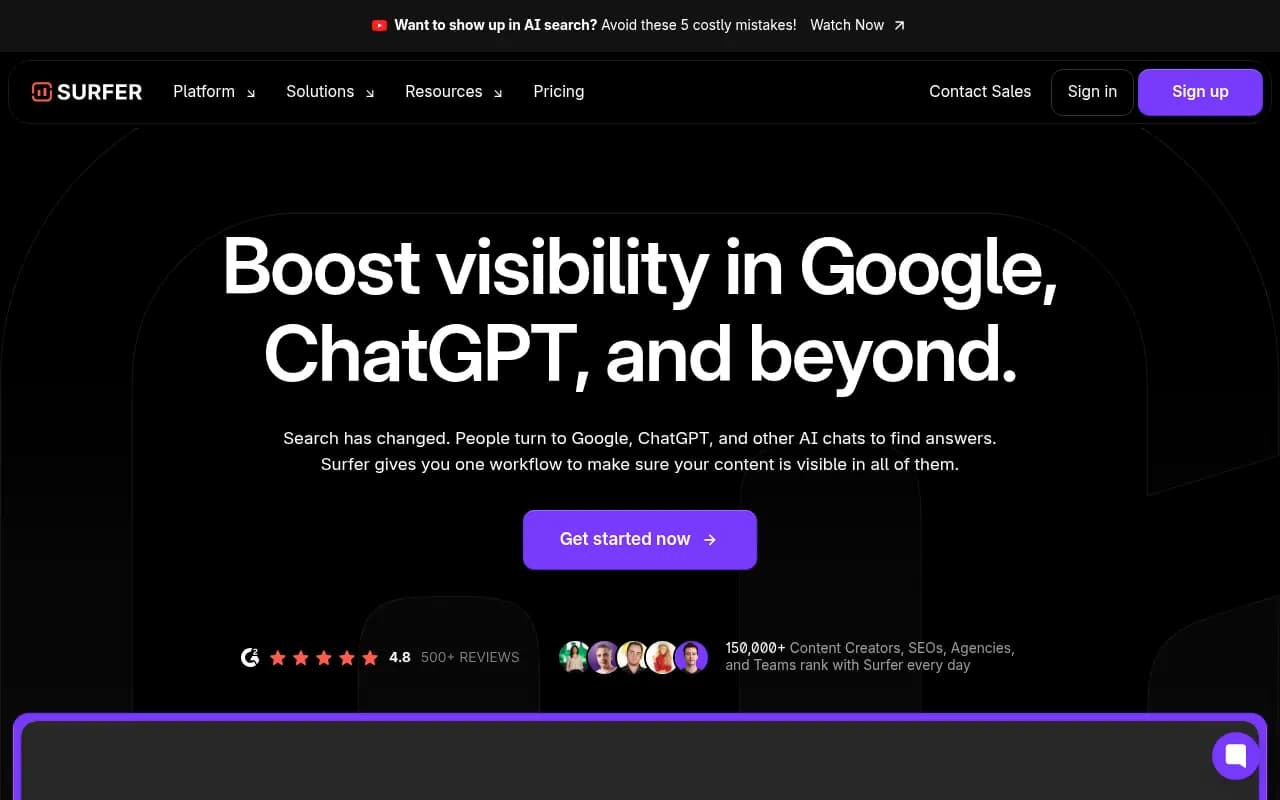
Surfer SEO is probably the most direct content-side alternative to MEGA SEO. Where MEGA SEO handles content creation as part of a broader autopilot system, Surfer focuses specifically on making your content score well against the pages currently ranking for your target keywords.
The core workflow: you pick a keyword, Surfer analyzes the top 20-50 ranking pages, and gives you a content score based on word count, keyword usage, heading structure, and NLP terms. Write or paste your content into the editor and the score updates in real time. It's genuinely useful for writers who want data-driven guidance without guessing what Google wants to see.
Surfer also has a keyword research tool, a site audit feature, and Surfer AI -- its article generation tool that writes content based on the same SERP analysis. The AI writing is decent but costs additional credits on top of your plan.
Compared to MEGA SEO, Surfer is more hands-on. You're doing the work; Surfer is giving you the data. MEGA SEO's agents do more of the execution. If you want to stay in control of your content and just want better optimization signals, Surfer is the right call. If you want someone (or something) to just handle it, MEGA SEO's model fits better.
One thing Surfer has added recently is AI search optimization -- it now claims to help content get visible in ChatGPT and other AI platforms. The feature exists, but it's not as deep as dedicated GEO tools.
Pricing: Essential $99/mo, Advanced $179/mo, Max $299/mo. 7-day money-back guarantee. Surfer AI articles cost extra credits.
Best for: Content teams and SEO writers who want real-time optimization guidance and are comfortable doing the actual writing themselves.
Semrush
Semrush is the kitchen sink of SEO tools. Keyword research, backlink analysis, site audits, rank tracking, competitor research, content marketing, PPC analysis, social media, local SEO -- it's all there. The platform has been around long enough that it's become the default choice for marketing teams that need one tool to cover everything.
Compared to MEGA SEO, Semrush is not an autopilot system. You're doing the strategy and execution yourself, with Semrush providing the data. That's a meaningful difference. MEGA SEO's value proposition is that the AI agents do the work; Semrush's value is that you have access to the best data to do the work yourself.
Semrush has added an AI Visibility Toolkit to track brand mentions in ChatGPT, Perplexity, and Gemini. It works, but the prompts are fixed -- you can't customize them the way you can with dedicated GEO platforms. It's more of a dashboard add-on than a core feature.
The pricing is a real consideration. Semrush starts at $165/mo for the Starter plan, which is quite limited. The Pro+ plan at $290/mo is where most teams actually land, and Advanced is $580/mo. That's significantly more than MEGA SEO for a tool that still requires you to do the work.
Where Semrush genuinely beats MEGA SEO: the depth of competitive intelligence. If you need to understand a competitor's entire backlink profile, their paid search strategy, their content gaps, and their traffic trends -- Semrush has no equal at scale.
Pricing: From $165/mo (Starter), $290/mo (Pro+), $580/mo (Advanced). 7-day free trial.
Best for: Marketing teams that need comprehensive competitive intelligence and are willing to invest time in the platform to get value from it.
Promptwatch

This one is different from the others on this list, and it's worth being clear about why.
MEGA SEO is built around traditional search -- getting your pages to rank on Google. Promptwatch is built around AI search -- making sure your brand gets mentioned when people ask ChatGPT, Perplexity, Claude, or Gemini questions in your category.
These are increasingly different problems. A page that ranks #1 on Google might never get cited by an AI model. And a brand that's invisible in AI responses is missing a growing share of how people discover products and services.
Promptwatch tracks your visibility across 10 AI models (ChatGPT, Claude, Gemini, Perplexity, Grok, DeepSeek, Copilot, Meta AI, Mistral, and Google AI Overviews). But the part that separates it from other AI monitoring tools is what happens after you see the data. The Answer Gap Analysis shows you exactly which prompts your competitors are visible for that you're not -- the specific content your site is missing. Then the built-in content agent generates articles, listicles, and comparison pages engineered to get cited by AI models, grounded in 880M+ citations analyzed. You track the results, see which pages AI models start citing, and connect it back to traffic.
Most AI visibility tools stop at the monitoring step. Promptwatch runs the full loop: find gaps, create content, track results.
It also has AI crawler logs -- real-time logs of when ChatGPT, Claude, and Perplexity crawl your pages, which pages they read, and any errors they hit. That's a feature most competitors don't have at all.
If you're already covered on traditional SEO and want to win in AI search, Promptwatch is the tool to look at. If you're starting from zero and need both, you'd likely run it alongside something like Surfer or SE Ranking.
Pricing: Free trial available. Plans from $99/mo (Essential), $249/mo (Professional), $579/mo (Business). Agency and Enterprise pricing available.
Best for: Brands and agencies that want to be visible in ChatGPT, Perplexity, and other AI search engines -- and want to actually do something about it, not just watch a dashboard.
SE Ranking
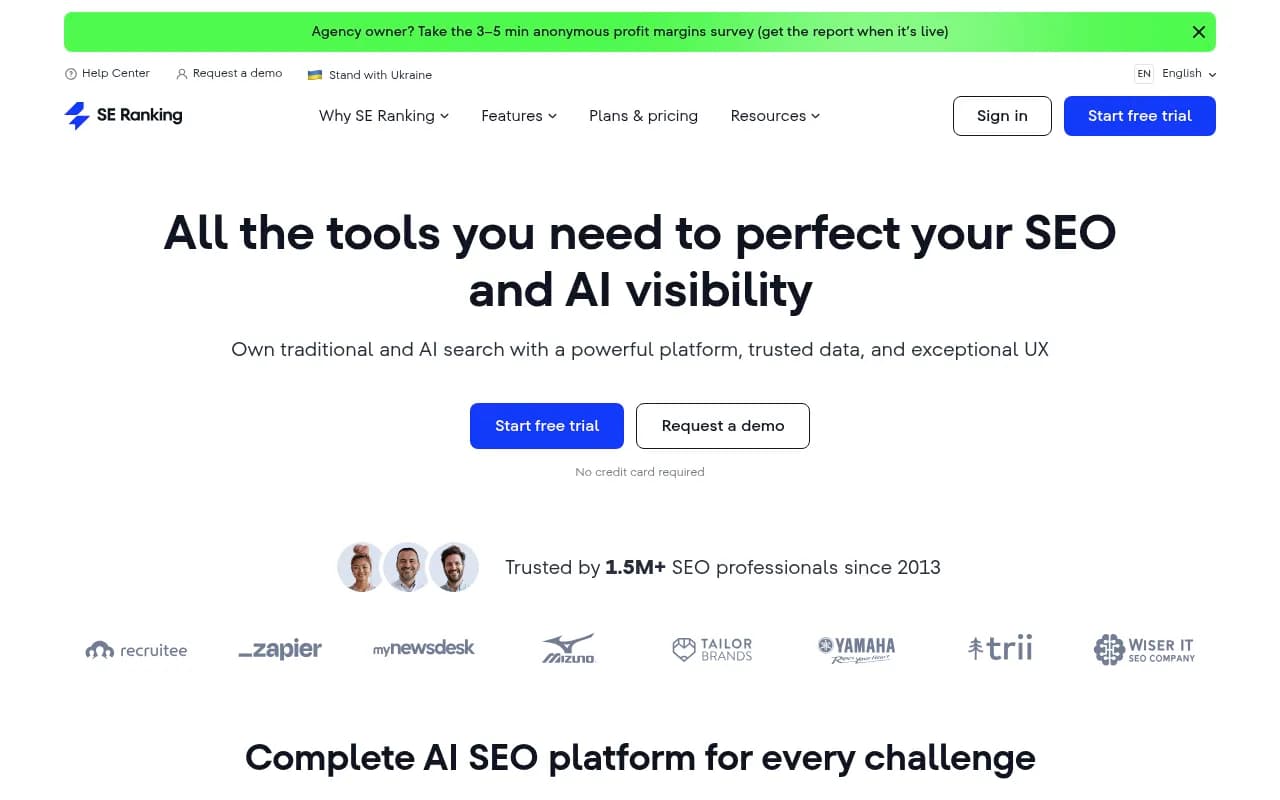
SE Ranking has been around since 2013 and has quietly built one of the more complete mid-market SEO platforms. It covers rank tracking, keyword research, site audits, backlink monitoring, content optimization, and white-label reporting -- all in one place, at a price point well below Semrush and Ahrefs.
The rank tracking is genuinely good. SE Ranking checks rankings daily across desktop and mobile, covers 188 countries, and lets you track at the city level on higher plans. For agencies managing multiple clients, the white-label reporting and client portal features are a real selling point.
Compared to MEGA SEO, SE Ranking is a manual tool -- you're doing the work, not an AI agent. The platform has added AI-assisted features (content editor, AI writing tools), but it's not trying to replace your SEO team. It's trying to give your SEO team better data and workflows.
SE Ranking recently added an AI Search add-on ($71.20/mo extra) for tracking brand visibility in AI platforms. It's a newer feature and not as deep as dedicated GEO tools, but it shows the platform is moving in that direction.
The pricing is one of SE Ranking's strongest arguments. The Core plan starts at $103.20/mo with annual billing, which is significantly cheaper than Semrush or Ahrefs for comparable traditional SEO functionality. The 14-day free trial with no credit card required is also a low-friction way to test it.
Pricing: Core from $103.20/mo, Growth from $223.20/mo (annual billing). AI Search add-on from $71.20/mo. 14-day free trial.
Best for: Agencies and in-house SEO teams that want comprehensive traditional SEO tools without paying Semrush prices, especially if white-label reporting matters.
Frase
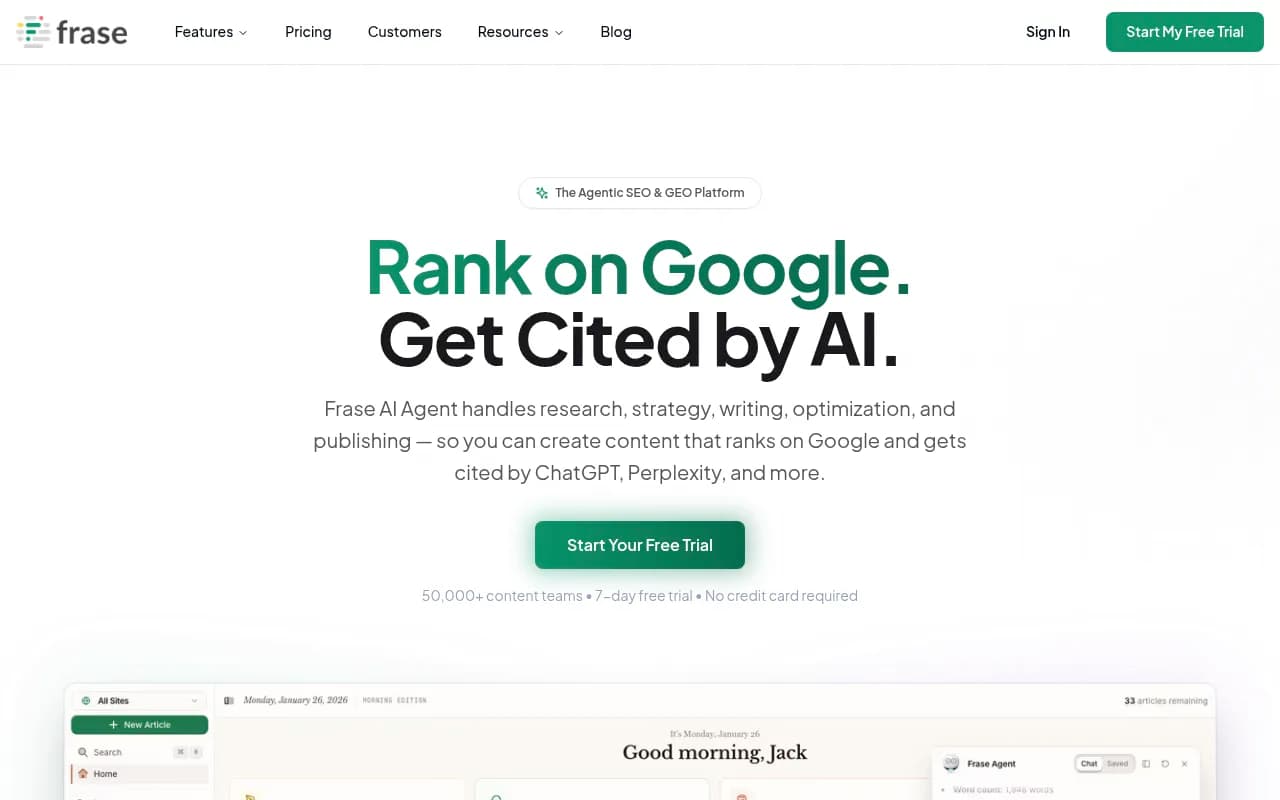
Frase sits in a similar space to Surfer SEO -- it's a content research and optimization tool -- but it has leaned harder into the GEO angle recently. The platform now bills itself as an "agentic SEO & GEO platform" that helps you rank on Google and get cited by AI.
The core workflow is research-first. You give Frase a topic or keyword, it analyzes the top SERP results, identifies content gaps, and generates a brief with an outline. Then you write (or let the AI write) directly in the editor, with optimization scores updating as you go. The research phase is genuinely good -- Frase surfaces questions, topics, and angles that competitors cover but you might miss.
The GEO features are newer and still developing. Frase tracks your visibility in ChatGPT and Perplexity and flags content gaps for AI citation. It's more integrated into the content workflow than Surfer's AI search features, but it's not as deep as a dedicated platform.
Compared to MEGA SEO, Frase requires more involvement. You're directing the research and reviewing the output. The AI does a lot of the heavy lifting, but it's not fully autonomous. That's actually a plus for teams that want quality control over their content.
Pricing is one of Frase's best features. The Starter plan at $39/mo is genuinely useful for solo operators or small teams. The Professional plan at $103/mo is where most teams land. Scale is $239/mo.
Pricing: 7-day free trial, then Starter $39/mo, Professional $103/mo, Scale $239/mo.
Best for: Content marketers who want research-driven content creation with some AI search optimization baked in, at a price point well below MEGA SEO.
Clearscope

Clearscope is the premium content optimization tool. It does fewer things than Surfer SEO or Frase, but what it does, it does very well. The content grading system is clean and reliable -- you get a letter grade based on how well your content covers the relevant terms and topics for a given keyword, and the recommendations are consistently actionable.
The platform has added AI search visibility tracking, letting you monitor how your content appears in ChatGPT and Gemini responses. The feature is more monitoring than optimization -- you can see what's happening, but Clearscope doesn't generate content or tell you specifically what to change to get cited more often.
Where Clearscope struggles compared to MEGA SEO is scope. MEGA SEO handles keyword research, content creation, technical SEO, and reporting. Clearscope is focused on content optimization. You'd need to pair it with other tools to cover everything MEGA SEO does.
The pricing reflects its premium positioning. At $189/mo for the Essentials plan, it's more expensive than Surfer's entry tier and significantly more than Frase. There's no free trial, though demos are available. The month-to-month billing with no contracts is a genuine plus.
Teams that use Clearscope tend to love it -- the interface is clean, the grades are reliable, and it integrates well with Google Docs and WordPress. But it's a tool for teams that already have an SEO strategy and need a better content optimization layer, not a replacement for a full platform.
Pricing: From $189/mo (Essentials). Business and Enterprise custom pricing. No free trial, demos available.
Best for: Content teams at established companies that want the best-in-class content optimization tool and are willing to pay for it.
Ahrefs
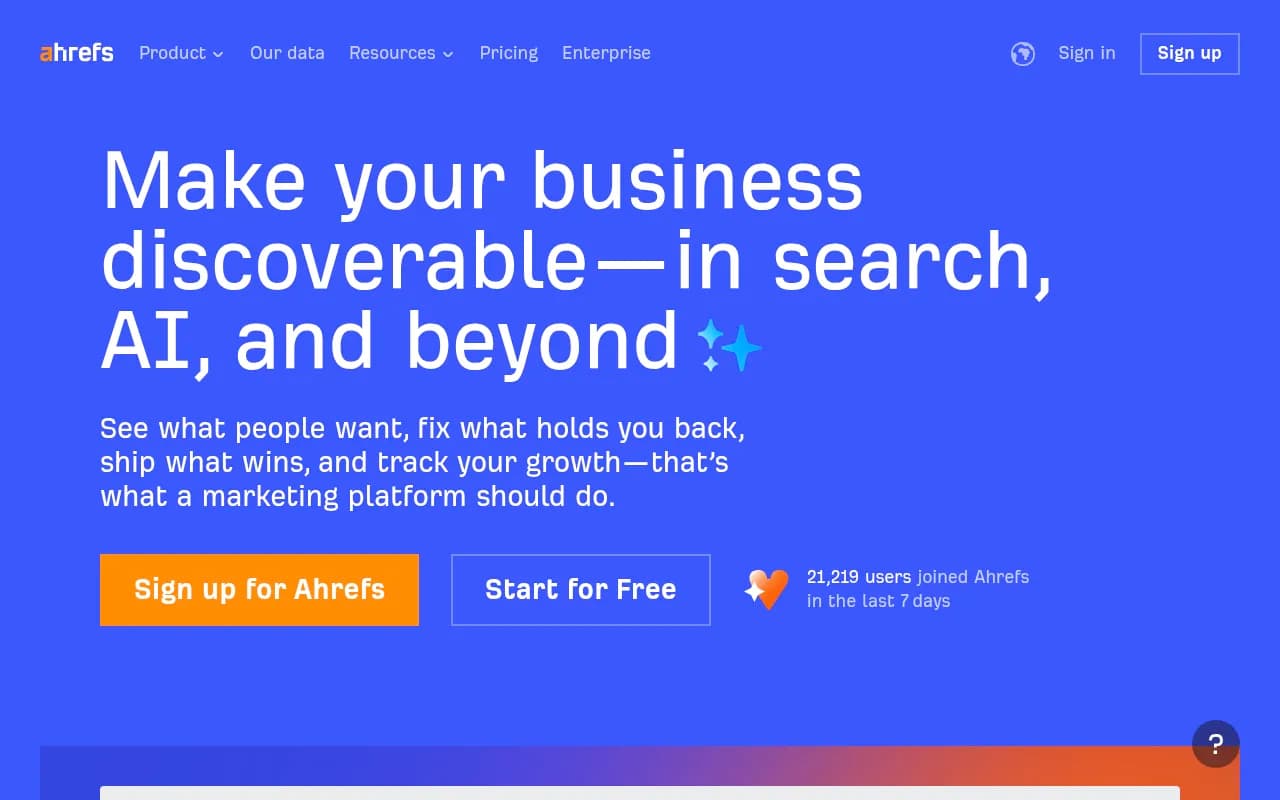
Ahrefs and Semrush are the two dominant platforms in traditional SEO, and choosing between them often comes down to personal preference. Ahrefs has the largest backlink index online, and its Site Explorer is widely considered the gold standard for backlink analysis and competitive research.
The platform covers everything: site audits, rank tracking, keyword research, content explorer, and now AI search monitoring through Brand Radar. Brand Radar tracks brand mentions across AI platforms, but like Semrush's AI features, it uses fixed prompts -- you can't customize the queries to match how your actual customers search.
Compared to MEGA SEO, Ahrefs is a research and analysis tool, not an execution platform. It tells you what to do; you do it. MEGA SEO's agents handle execution. If you have an SEO team that knows what to do with data, Ahrefs gives them better data than almost anything else. If you don't have that team, MEGA SEO's autopilot model might actually deliver more results.
The pricing structure is a bit odd. The Starter plan at $29/mo sounds cheap but is extremely limited -- it's really a trial tier. The Lite plan at $83/mo is the actual entry point for real use, and Standard at $166/mo is where most teams land. Enterprise pricing is custom.
Ahrefs has also been building out content and social media tools, positioning itself as a broader marketing platform. The content tools are decent but not as focused as Surfer or Frase.
Pricing: Starter $29/mo (very limited), Lite $83/mo, Standard $166/mo, Advanced $333/mo. 20% discount on annual billing.
Best for: SEO professionals and teams that need the deepest backlink data and competitive intelligence available, and have the expertise to act on it.
Ubersuggest
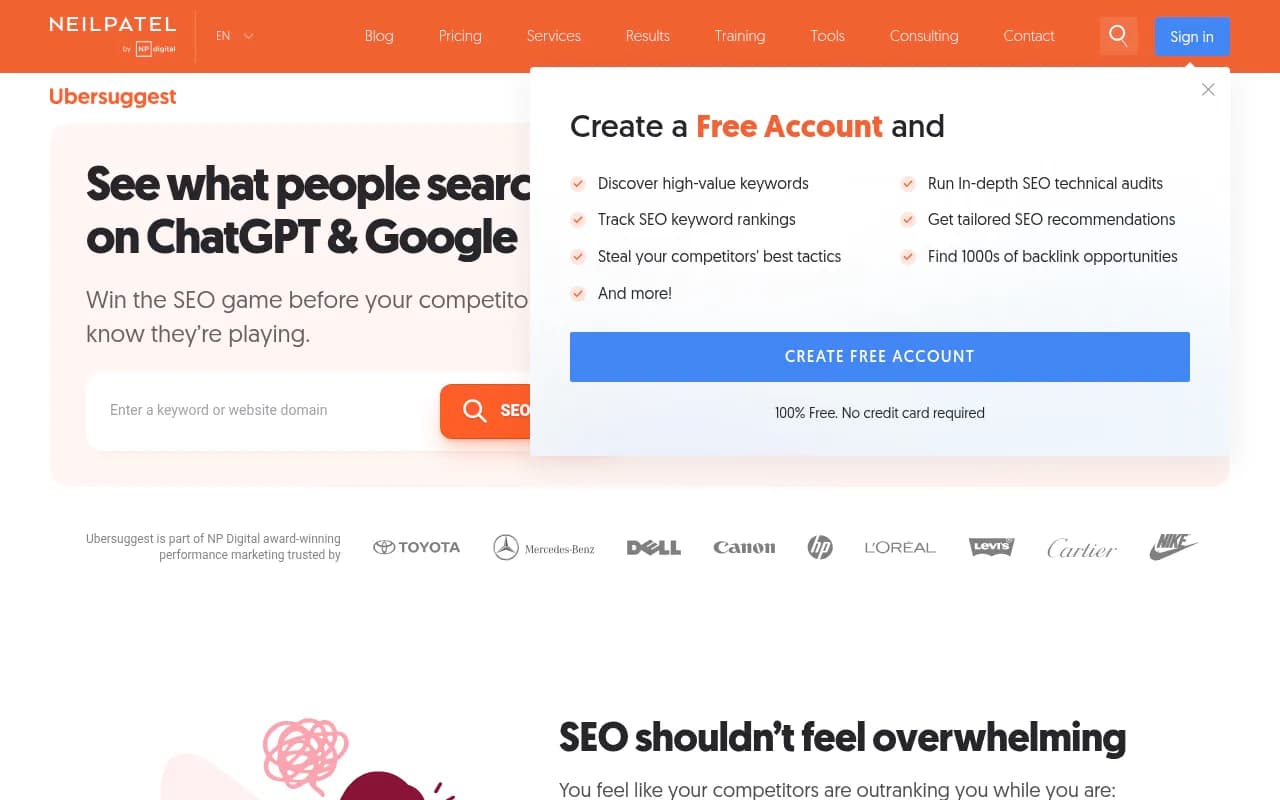
Ubersuggest is Neil Patel's free keyword research tool, and it's worth mentioning because the price-to-value ratio at the free tier is hard to beat. You get keyword suggestions, search volume data, competition scores, content ideas, and a basic site audit -- all for free, with a limit of 3 searches per day.
The paid plans are also unusually cheap. Monthly subscriptions start at $29/mo, and the lifetime plans ($290 for Individual, $490 for Business) are genuinely interesting for anyone who wants to avoid recurring costs.
The trade-off is depth. Ubersuggest's data is less comprehensive than Ahrefs or Semrush, the backlink database is smaller, and the content tools are basic. It doesn't have AI search tracking, content optimization scoring, or anything close to MEGA SEO's autopilot features.
Compared to MEGA SEO, Ubersuggest is a completely different category. MEGA SEO is an execution platform; Ubersuggest is a research tool. They're not really competing for the same use case. But if someone is looking at MEGA SEO primarily for keyword research and is on a tight budget, Ubersuggest covers the basics at a fraction of the cost.
Pricing: Free (3 searches/day), Individual $29/mo or $290 lifetime, Business $49/mo or $490 lifetime, Enterprise $99/mo or $990 lifetime.
Best for: Solo operators, bloggers, and small businesses that need basic keyword research and can't justify $100+/mo for a full SEO platform.
Screaming Frog SEO Spider
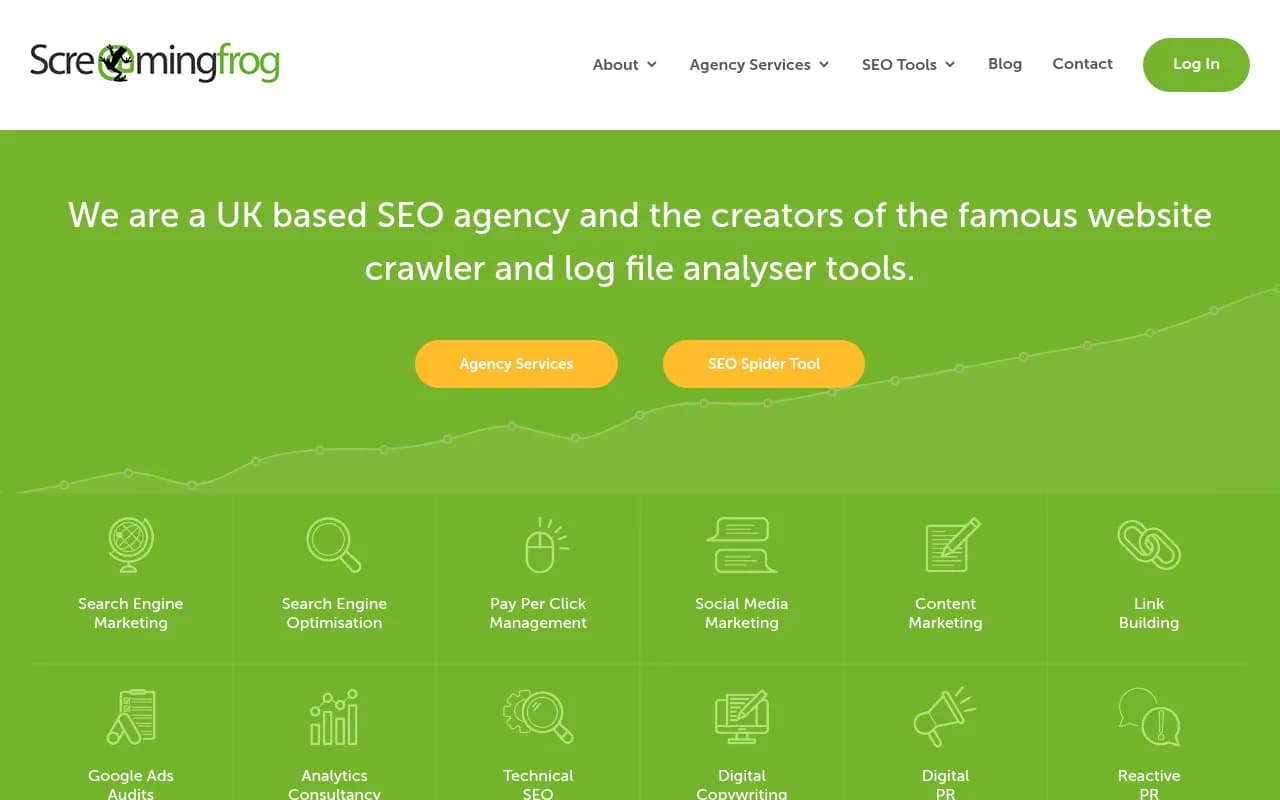
Screaming Frog is a desktop crawler, not a platform. It crawls your website and produces a detailed report of technical SEO issues: broken links, redirect chains, missing meta tags, duplicate content, page speed issues, structured data errors, and more. It's been the go-to technical SEO audit tool for over a decade.
The free version crawls up to 500 URLs, which is enough for small sites. The paid license is £199/year for unlimited crawling -- remarkably cheap for what it does.
Compared to MEGA SEO, Screaming Frog is purely diagnostic. It finds technical problems; it doesn't fix them, create content, or track rankings. MEGA SEO's technical SEO features are more automated (the agents identify and fix issues), but Screaming Frog goes deeper on the diagnosis side.
Most serious SEO teams use Screaming Frog alongside a platform like Ahrefs or Semrush. It's not a replacement for MEGA SEO -- it's a specialist tool for a specific job. If technical SEO audits are the main thing you're paying MEGA SEO for, Screaming Frog at £199/year is a dramatically cheaper way to get the crawl data. You'd just need to do the fixing yourself.
Pricing: Free up to 500 URLs, £199/year for unlimited crawling.
Best for: Technical SEO specialists and agencies that need detailed crawl data and are comfortable interpreting and acting on the results themselves.
Which alternative should you pick?
The right choice depends on what you actually need from MEGA SEO.
If you want a similar autopilot approach but with more focus on content quality, Frase at $39-103/mo is worth trying first. It's not fully autonomous, but the research-to-content workflow is fast and the price is much lower.
If you need the deepest traditional SEO data and have a team to act on it, Ahrefs or Semrush are the standard choices. Ahrefs edges ahead for backlink analysis; Semrush has more breadth across PPC and social. Both require significantly more hands-on work than MEGA SEO.
If you're an agency managing multiple clients and need white-label reporting, SE Ranking hits a sweet spot between features and price that neither Semrush nor MEGA SEO quite matches.
If content optimization is your primary concern, Surfer SEO at $99/mo is the most focused tool for that job. Clearscope is better if you're at a larger company and want the cleanest interface, but the price jump to $189/mo is hard to justify for smaller teams.
If you're specifically worried about AI search -- how your brand appears in ChatGPT, Perplexity, and Gemini -- none of the traditional SEO tools handle this well. Promptwatch is built specifically for that problem, with the full loop from gap analysis to content creation to tracking results. It's a different tool for a different (and increasingly important) problem.
And if budget is the main constraint, Ubersuggest's free tier covers basic keyword research, and Screaming Frog's free version handles technical audits up to 500 URLs. Neither replaces MEGA SEO, but together they cover the fundamentals at near-zero cost.