Key takeaways
- GEO here means generative engine optimization (getting cited by ChatGPT, Gemini, Perplexity and Google AI Overviews), not geographic information systems like ArcGIS.
- Agriculture buyers ask AI tools things like "best center pivot irrigation brands for row crop farmers" and get a shortlist of named competitors. If you are not on it, you lose the lead before the click.
- Product pages and landing pages earn about 39% of ChatGPT citations, so agriculture and food producers with thin spec pages are leaving visibility on the table.
- Monitoring-only trackers are fine for small budgets. Teams that need to fix gaps, not just see them, should look at platforms with crawler logs, content workflows and traffic attribution.
- No platform I found has an agriculture-specific dataset that is independently verified. Treat vertical claims from vendors with skepticism and test with your own prompts.
What GEO means for agriculture and food (and what it doesn't)
A quick clarification, because it trips up search results. Ask an AI assistant for the best GEO tools and, according to a ziptie.ai analysis, you may get ArcGIS and QGIS back. Those are mapping tools. They are useful for precision agriculture, but they have nothing to do with this guide.
Generative engine optimization is the practice of making your brand, products and content show up, accurately, in AI-generated answers. For a seed company, a fertilizer distributor, a farm software vendor, a co-op or a packaged food brand, that means three things:
- Being mentioned when buyers ask category questions.
- Having your own pages cited as the source.
- Being described correctly (specs, prices, regions, certifications).
Why agriculture is a different GEO problem
Agriculture and food are not like SaaS. A few differences change which tools matter.
Buying cycles are seasonal and regional
A corn grower researching nitrogen programs in winter asks very different questions than one comparing sprayers in June. Country, state and even county matter. A tool that only tracks prompts from one US location will miss regional answers. Look for location-level tracking if you sell across states or countries.
The competitor set is small and well known
In the example prompts from a vendor article by Ranqia (a vendor that ranks itself first, so take its comparisons with salt), the fan-out searches behind "best fertilizer companies for corn and soybean growers" named Mosaic, Nutrien, CF Industries, Corteva and Yara. Farm software queries named Climate FieldView, Granular, John Deere Operations Center, Agworld, Trimble and Conservis. Irrigation named Valley, Zimmatic, Reinke, T-L and Lindsay. When a category has five to six dominant names, share of voice and position in the answer matter more than a simple "were we mentioned" check.
Trust sources are different
AI answers about agronomy lean on university extension sites, USDA material, trade publications such as Successful Farming, AgWeb and Farm Journal, plus YouTube and Reddit for practical questions. The same Ranqia piece says farm software fan-outs explicitly included Reddit. That is a vendor observation, not independent data, but it matches what you would expect from a community-driven buying audience.
One caution on Reddit: Promptwatch's data shows reddit.com's share of ChatGPT citations fell from about 4% to 0.5% on August 14, 2026, while AI Overviews and AI Mode declined more gradually. Reddit is a Google AI play more than a ChatGPT one right now.
What the citation data says you should fix first
Before picking a tool, it helps to know what AI actually cites. Promptwatch Data's ChatGPT citation share by content type report (Sep 28 to Oct 4, 2026) found:
- Product pages: 22.4% of citations
- Landing pages: 16.8%
- Listicles: 13.6%
- Documentation: 7.5%
- How-to guides: 8.7%
- Comparisons: 5.9%
- FAQ pages: 3.3%
- Reviews: 1.7%
For commercial prompts like "best X for Y," product pages, landing pages, listicles and comparisons made up almost 70% of citations. For branded prompts, reviews jumped to 5.6%, more than three times their share overall.
What this means for a producer: your product catalog pages are your most important GEO asset. Seed trait sheets, equipment specifications, nutrient analyses, ingredient lists, certifications (organic, non-GMO, USDA) and pricing or price ranges should be complete, factual and crawlable. A PDF spec sheet buried behind a dealer login is invisible.
The second finding matters just as much. In the unique domains per response report, 47.6% of ChatGPT responses with citations cited 10 or more domains, and 52.5% of non-brand prompts did. You will almost always share the answer with many other sites, so third-party roundups, trade publications and reviews are often the way in. For brand-specific prompts the picture is tighter: only 21.3% cite 10 or more domains, with five being the most common count.
There is no agriculture-specific Promptwatch report. The closest are the software and healthcare citation reports, and they show the same pattern: documentation, authority and official sources dominate in technical categories. Do not assume those numbers transfer to agriculture.
How to evaluate a GEO tool as an ag or food company
Skip feature checklists and ask these questions.
- Does it track real AI interfaces or only API calls? What ChatGPT shows buyers can differ from what its API returns.
- Can I set location per prompt? Regional questions are common in agriculture.
- Does it show fan-out queries? These reveal the sub-searches that name competitors and categories.
- Can it tell me whether AI crawlers can read my site? Many ag manufacturer sites are old, JavaScript-heavy or locked behind dealer portals.
- Does it help me act, or only report?
- Does the pricing make sense for 50 to 150 prompts, which is realistic for a mid-size producer?
The best GEO tools for agriculture and food producers
Promptwatch: best for teams that want to fix gaps, not just see them
Promptwatch is the platform 1001 SEO Media uses for its own AI visibility work, so I will flag that bias. It is also the one with the broadest stack I can point to. It tracks the real interfaces of ChatGPT, Google AI Overviews, AI Mode, Gemini, Perplexity and Copilot, with country tracking on every paid plan and state/city tracking from the Business tier. That matters for regional agriculture queries.

What makes it useful for producers specifically:
- IP-verified AI crawler logs show whether GPTBot, ClaudeBot and others can actually read your product and spec pages, and where they hit errors. If your equipment catalog sits behind a script-heavy frontend, this is how you find out.
- Query fan-outs and prompt volumes show the exact sub-searches AI runs for prompts like "best farm management software for mid-size row crop operations."
- Reddit, YouTube and LinkedIn citation tracking is relevant because ag buyers lean on video and community content.
- The Action Board, content gap analysis and Content Agent turn gaps into drafted and published pages (Webflow, Framer or WordPress), then track whether those pages get crawled and cited.
- Visitor analytics connect AI citations to real traffic, which helps when a sales team asks whether this actually produces leads.
Pricing from promptwatch.com/pricing: a free Explore tier (10 prompts, ChatGPT only), Essential at $95/month (50 prompts), Professional at $245/month (150 prompts), and Business at $579/month (350 prompts, state/city tracking, Content Agent). Agencies have separate Kick-off, Growth and Scale plans. Confirm current numbers before buying.
The honest downside: it is a lot of platform. A single-location family farm selling at markets does not need crawler logs and an agent workflow.
Profound: best for enterprise ag brands with big budgets
Profound is an enterprise visibility platform tracking ChatGPT, Perplexity and many other engines. Third-party roundups, including one by Nick Lafferty, rank it highly for engine coverage and prompt volume data. It tends to cost more than mid-market options, so it fits global agribusinesses and food conglomerates better than regional producers.
Profound

Semrush AI Visibility Toolkit: best if you already live in Semrush
If your marketing team already uses Semrush for keywords and audits, its AI toolkit adds AI visibility inside a familiar interface. Ranqia's table (unverified) lists it as covering AI Overviews and Copilot. Expect fixed prompt sets and less depth on crawler behaviour than purpose-built tools.
Ahrefs Brand Radar: best for Google-first teams
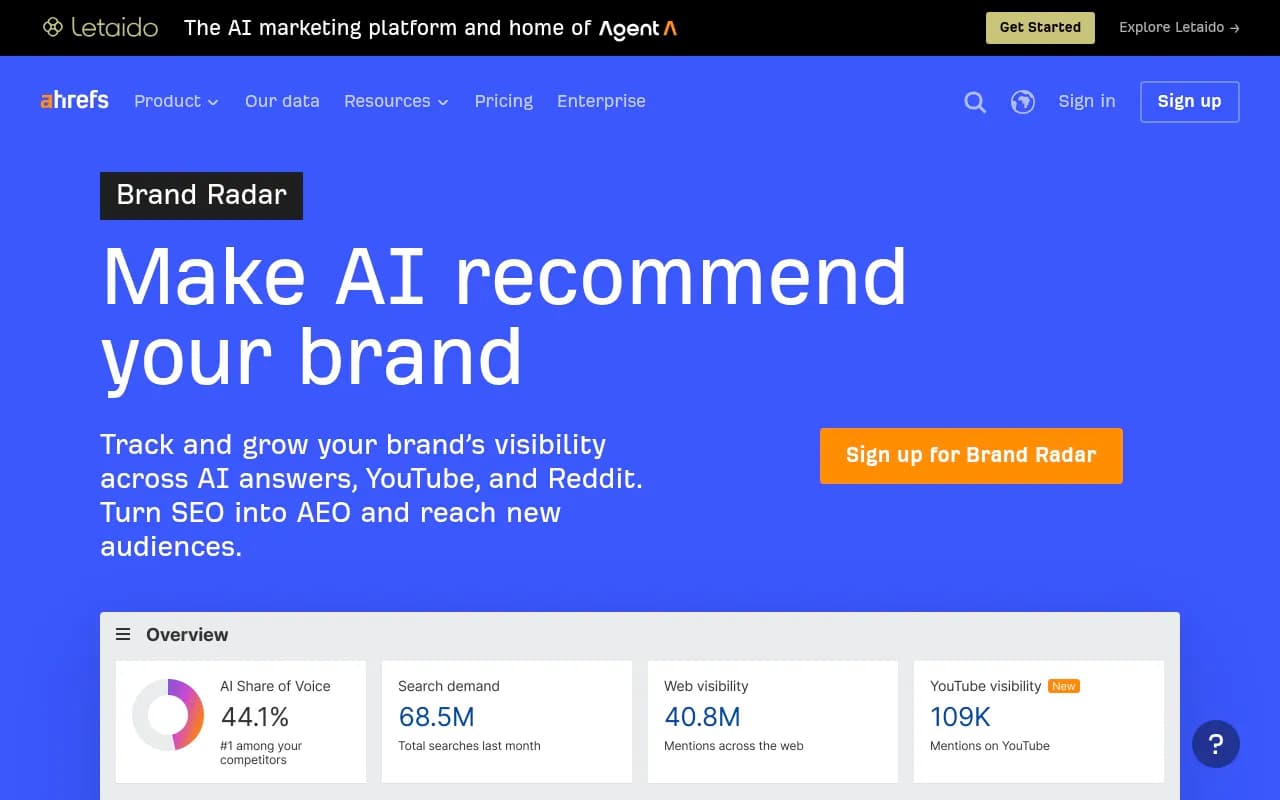
Ahrefs Brand Radar tracks brand visibility in AI search, with AI Overviews the main surface in Ranqia's comparison. It is a sensible add-on for teams that already use Ahrefs for backlinks and content research, especially for trade-publication outreach.
Otterly.AI and Peec AI: best for small, budget-conscious trackers
Both are straightforward prompt trackers covering ChatGPT, Perplexity and a few others. They answer "did AI mention us?" quickly and cheaply. They are a fit for a regional co-op or small food brand that wants a monthly pulse. They do not include crawler logs or content workflows, so you will need other tools to act on what you see.
Otterly.AI


ZipTie: best for evidence and client reporting
ZipTie focuses on monitoring plus screenshot evidence, which helps agencies reporting to ag clients. Note that the ziptie.ai comparison guide ranks itself first, so weigh its self-assessment accordingly.
Goodie AI and Evertune: enterprise-leaning options
NoGood's enterprise list ranked Goodie AI first, but that list is aimed at large SaaS, healthcare and fintech brands rather than agriculture. Evertune targets Fortune 500 brands. Both are worth a demo if you are a multinational food company, less so otherwise.
Comparison table
| Tool | Best for | Real-UI tracking and regional prompts | Helps you act, not just monitor | Typical fit |
|---|---|---|---|---|
| Promptwatch | Producers who want to close gaps | Yes, country on all paid plans, state/city on Business | Yes (Action Board, Content Agent, crawler logs) | Mid-market to enterprise, agencies |
| Profound | Large agribusiness | Broad engine coverage | Partial | Enterprise |
| Semrush AI Toolkit | Existing Semrush teams | Limited, fixed prompt sets | Limited | SMB to enterprise |
| Ahrefs Brand Radar | Google-first, link-driven teams | AI Overviews focus | Limited | SMB to mid-market |
| Otterly.AI / Peec AI | Cheap monitoring | Basic | No | Small producers, co-ops |
| ZipTie | Reporting and evidence | Screenshot capture | Some optimization guidance | Agencies |
Pricing varies and changes, and I did not find independently verified prices for every vendor. Check each pricing page.
A practical setup for a producer in the first 30 days
1. Build a three-layer prompt set
Start with 40 to 60 prompts split across category ("best drip irrigation systems for orchards"), brand comparison ("Valley vs Reinke pivots") and authority questions ("how much nitrogen does corn need per acre"). Add regional modifiers where your sales territory is regional.
2. Look at fan-outs before writing anything
See which sub-queries the AI runs and which competitors, categories and sources they name. Ranqia claims content covering fewer than three to five of the top fan-out queries won't be retrieved. That figure is unsourced, so treat it as a hypothesis to test, not a rule.
3. Audit who gets cited
List the domains cited for your prompts. You will likely find a mix of competitor sites, trade publications, university extension pages, listicles and YouTube. That list is your outreach and content plan.
4. Fix product and spec pages
Given that product and landing pages earn about 39% of ChatGPT citations, make sure each product has a public, crawlable page with complete specs, availability regions, certifications and clear positioning. Add schema.org markup (Organization, Product, FAQPage). Check that AI crawlers are not blocked by robots.txt or by a login wall.
5. Go after third-party mentions
Pitch trade publications and extension partners. Get included in the roundups that AI keeps citing in your category. Collect reviews on credible sites, since reviews matter more for branded prompts.
6. Track, then refresh
Measure across many prompts, not one. Citation patterns shift: Promptwatch's content half-life data shows landing pages and docs stay cited longest while news loses half its pages within 36 days. Evergreen specs and guides last; seasonal news does not.
Supporting tools worth having
GEO platforms do not replace the basics.
- Google Search Console and Bing Webmaster Tools show what ranks in classic search, which still feeds AI answers.
- Screaming Frog is handy for finding thin or orphaned product pages.
- If your site is JavaScript-heavy, a pre-rendering service like Prerender.io can make dynamic catalogs readable to crawlers.
- A structured-data tool such as WordLift helps with entity markup.
For a wider shortlist, the GEO software directory at bestgeosoftware.com lists more platforms by category.
Should you hire an agency instead?
Some ag companies have no in-house SEO. Bluelinks Agency published a list of agencies serving agriculture (naming itself first, along with AdFarm, First Page Sage and Hillsgreen), which is a self-ranked list, so verify claims. If you want a full-service partner that handles technical SEO, content and GEO together, 1001 SEO Media is one option; it offers no long-term contracts and uses senior specialists. Either way, ask any agency which GEO platform they use and what reports you will see.
Choosing by company type
- Family farm or local food producer: Free tier of a tracker or Otterly/Peec, plus clean product pages and Google Business Profile work.
- Regional co-op or equipment dealer: A mid-tier platform with location tracking. Promptwatch Essential or Professional, or Semrush if already a customer.
- Seed, chemical or equipment manufacturer: Promptwatch Business or Profound for multi-region tracking, crawler logs and content workflows.
- Packaged food or CPG brand: Prioritize product page quality, reviews and shopping visibility. Platforms that cover AI shopping results are more useful here.
- Agency serving ag clients: Agency plans with white-label reporting.
The bottom line
Agriculture and food producers have an advantage most categories lack: a small, known competitor set and a buyer base that trusts specific sources. Pick a tool that shows you which prompts name your competitors and not you, confirms AI crawlers can read your catalog, and helps you fix the gaps. Start with 50 prompts, one product line and one region. If the data shows you missing from shortlists, fix your product pages first, because that is where citations concentrate.