Omni Review 2026
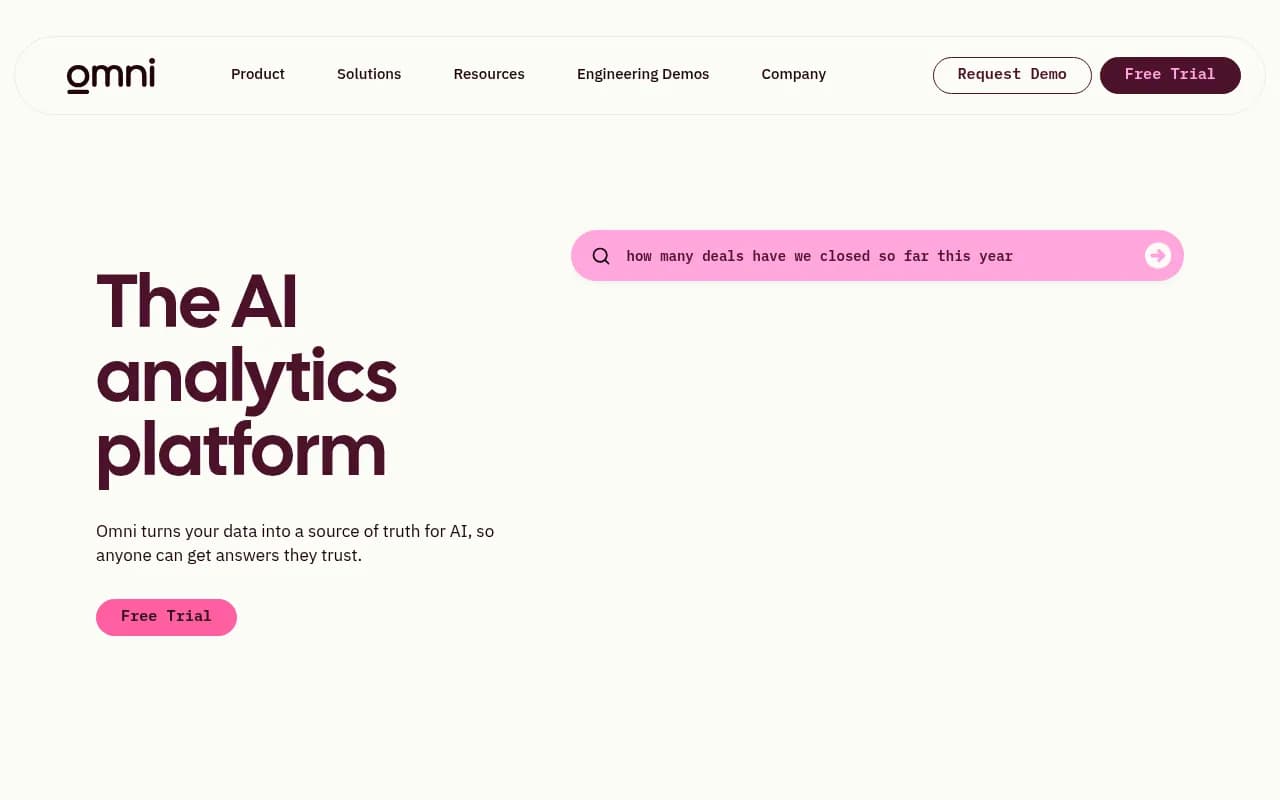
A business intelligence platform that combines a semantic layer with a SQL-friendly interface and self-serve dashboards. Designed to bridge the gap between data teams and business users.
Key takeaways
- Omni positions itself as an "AI analytics platform" built around a governed semantic layer, letting business users ask natural-language questions while data teams retain control over definitions and logic.
- The platform covers the full BI stack: SQL IDE, point-and-click explorer, spreadsheet workbooks, dashboards, and an AI chat interface called Blobby -- all in one product.
- Strong integration story with dbt, Snowflake, Databricks, BigQuery, and an MCP server that lets external AI tools (Claude, ChatGPT, Cursor) query your semantic layer directly.
- Pricing is not publicly listed in detail; community reports suggest a platform fee around $2,800/year plus per-user costs, making it mid-market to enterprise territory.
- Not a fit for solo analysts or small teams on tight budgets -- the pricing and complexity are aimed at companies with dedicated data teams.
- Actively shipping fast: weekly engineering demos are public, and the product has moved significantly toward AI-native workflows in 2025-2026.
Omni Analytics launched out of stealth in 2022, founded by Colin Zima and Chris Merrick, both alumni of Looker. That lineage is obvious the moment you use the product -- the semantic modeling approach, the LookML-adjacent model layer, and the emphasis on governed self-serve analytics all feel like a spiritual successor to what Looker was trying to do before Google acquired it and slowed development. But Omni isn't just a Looker clone. The team has rebuilt the experience from scratch with a modern stack, added spreadsheet-style workbooks, and in 2025-2026 leaned hard into AI as the primary interface for business users.
The core problem Omni is solving is one that every data team knows well: business users want answers now, data teams are drowning in ad-hoc requests, and the BI tools in between are either too rigid for analysts or too complex for non-technical users. Omni's answer is to make the semantic layer the single source of truth, then layer multiple interfaces on top of it -- SQL for analysts, point-and-click for power users, AI chat for everyone else. Customers like Cribl (700+ monthly users), BambooHR (embedded analytics in their product), and Guitar Center have publicly talked about this as the reason they chose Omni over alternatives.
The target audience is data teams at growth-stage to mid-enterprise companies -- typically 50 to 5,000 employees -- who have outgrown simple dashboarding tools like Metabase or Redash but find Tableau or legacy Looker too slow to iterate on. Omni also has a meaningful embedded analytics use case, with product teams at companies like BambooHR using it to ship customer-facing analytics without building a custom BI layer.
Key features
Semantic layer and model governance
The semantic layer is the foundation everything else builds on. Data teams define metrics, dimensions, joins, and access filters in Omni's model, and those definitions propagate to every interface -- AI chat, SQL, point-and-click, and dashboards. This means when a business user asks "what was our revenue last quarter?" the AI isn't guessing what "revenue" means; it's querying a definition the data team has explicitly approved.
The model supports branch mode, which lets you tune AI context or test new metric definitions without affecting what's live in production. Git integration (GitHub supported) means model changes go through version control, so you can review, roll back, and manage changes the same way you'd manage code.
AI chat (Blobby)
Omni's AI chat interface is called Blobby. Users type questions in natural language, and Blobby translates them into queries against the semantic layer. The key differentiator here versus generic text-to-SQL tools is that Blobby operates within the governed model -- it can only access fields and metrics the data team has defined and permissioned. This prevents the hallucination problem that plagues raw LLM-to-database connections.
The chat experience supports follow-up questions with context carrying over, inline filtering and field additions, and the ability to escalate from a chat answer into a full workbook for deeper exploration. There's also a debug agent for Blobby sessions -- a side drawer that lets you inspect exactly what Blobby saw and did, which is genuinely useful for diagnosing unexpected outputs.
Spreadsheet workbooks
This is one of Omni's more distinctive features. Workbooks give analysts a spreadsheet-like interface with familiar formulas, but the underlying data is live and governed -- not a static export. You can do forecasting, modeling, and ad-hoc calculations on top of real warehouse data without the usual copy-paste-into-Excel workflow. For analysts who live in spreadsheets but need to work with data at scale, this is a meaningful quality-of-life improvement.
SQL IDE
For analysts who want to write raw SQL, Omni provides a full IDE with intelligent autocomplete that's aware of your schema and semantic model. Queries written in the SQL IDE can be promoted into the model, so ad-hoc analysis can become governed metrics without a separate workflow. This is a cleaner loop than most BI tools, which treat SQL and the semantic layer as separate concerns.
Dashboards and point-and-click exploration
The dashboard builder (introduced in June 2026) supports custom visualizations, drill-downs, and filters. The point-and-click explorer uses a field picker and chart editor that non-technical users can navigate without writing any SQL. Both interfaces pull from the same semantic layer, so there's no risk of different dashboards showing different numbers for the same metric.
MCP server and AI platform integrations
Omni has an MCP (Model Context Protocol) server that exposes your semantic layer to external AI tools. Claude, ChatGPT, and Cursor can all query your Omni data directly through this interface. There are official connectors listed on Claude's connector directory and ChatGPT's app directory. This is a forward-looking bet -- as AI coding assistants and chat tools become primary interfaces for knowledge workers, having your data accessible through MCP means Omni's semantic layer becomes the data backbone for a broader AI stack.
Modeling agent and agent skills
The built-in Modeling Agent helps data teams build out the semantic model faster -- it can suggest metrics, add AI context to fields, and incorporate existing documentation. Agent Skills are pre-packaged behaviors you can invoke in the chat interface to run queries, build models, or manage content. The CLI lets you manage your Omni instance programmatically via APIs.
Embedded analytics
Omni supports white-label embedding with SSO, APIs, and the MCP server. Product teams can ship customer-facing analytics without building a custom BI layer. BambooHR is the most public example -- their customers build custom reports and dashboards inside BambooHR without knowing Omni is powering it. The embedding story is competitive with tools like Metabase's embedded edition or Sigma Computing.
AI-written summaries and metric diagnostics
Beyond chat, Omni can schedule AI-written summaries of metric changes and deliver them to Slack or other channels. The platform can also automatically diagnose why a metric changed -- identifying drivers and drags -- which is the kind of analysis that would normally require an analyst to dig in manually.
Who is it for
The primary user is a data team of 2-10 analysts at a company with 100-2,000 employees, sitting on a modern data stack (Snowflake, Databricks, or BigQuery, likely with dbt). They're getting buried in ad-hoc requests from business stakeholders and want to build a self-serve layer that actually gets used. Omni's combination of a governed semantic model and an AI chat interface is a credible answer to that problem -- business users can ask questions without filing tickets, and the data team controls what answers are possible.
The second major persona is a product team building embedded analytics. If you're a SaaS company that needs to give customers reporting and dashboards inside your product, Omni's embedding capabilities let you ship that without a multi-quarter custom build. BambooHR and Photoroom are real examples of this working at scale.
Omni is less suited to solo analysts or small startups without a dedicated data function. The semantic modeling layer requires upfront investment to set up correctly, and the pricing (estimated around $2,800+ platform fee plus per-user costs) puts it out of reach for teams that just need a simple dashboard tool. If you're a 10-person startup with one data person, Metabase or even a well-configured Looker Studio setup will serve you better.
Industries where Omni seems to be gaining traction include media (Condé Nast, BuzzFeed), fintech (Mercury), HR tech (BambooHR), and e-commerce (Guitar Center, Caraway). The common thread is companies with complex data models and a mix of technical and non-technical stakeholders who need to work from the same numbers.
Integrations and ecosystem
Omni connects to most major data warehouses and databases:
- Cloud warehouses: Snowflake, Google BigQuery, Databricks, Amazon Redshift, MotherDuck
- Databases: PostgreSQL, MySQL, ClickHouse, Microsoft SQL Server, Trino
- Transformation: dbt (with a dedicated integration that imports dbt models and documentation into the semantic layer)
- Version control: GitHub (Git integration for model management)
- AI platforms: Claude (official connector), ChatGPT (official app), Cursor (MCP setup), custom chatbots via MCP server
- Alerting: Slack (for AI-written summaries and metric alerts)
The API and CLI give developers programmatic access to manage models, run queries, and automate workflows. The MCP server is the most interesting integration story right now -- it's a bet that AI assistants will become primary data interfaces, and Omni wants to be the governed layer underneath them.
There's no native mobile app mentioned, and the product is web-based. Browser extension support isn't part of the current offering.
Pricing and value
Omni doesn't publish pricing on its website -- you need to request a demo to get a quote. Based on community discussions (a Reddit thread in r/BusinessIntelligence), one pricing structure mentioned is approximately:
- Platform Standard: ~$2,800/year
- Developer users: ~$400 each
- Standard users: ~$600 each (in packs of 10)
- Viewer users: ~$300 each (in packs of 10)
These numbers are from community reports and may not reflect current pricing or all available tiers. Omni offers a free trial, and annual billing is standard.
For context, this puts Omni in a similar range to Sigma Computing and above Metabase's commercial tiers, but below enterprise Looker or Tableau contracts. For a data team that's currently paying for Looker and frustrated with slow development cycles, Omni is likely cheaper and faster to iterate on. For a team considering Metabase, Omni is more expensive but offers a meaningfully more capable semantic layer and AI features.
The value proposition is strongest for teams where the cost of analyst time spent on ad-hoc requests is high. If your data team is spending 40% of their time on one-off queries, and Omni's self-serve layer reduces that to 20%, the ROI math works quickly.
Strengths and limitations
What Omni does well:
- The semantic layer is genuinely well-designed. The branch mode, Git integration, and the ability to promote SQL queries into governed metrics are thoughtful features that reflect real experience with how data teams work. The Guitar Center quote about being "primed for AI because the semantic model is at the heart of the platform" captures something real -- a governed model makes AI answers trustworthy in a way that raw text-to-SQL doesn't.
- Multiple interfaces, one source of truth. Having SQL, point-and-click, spreadsheet workbooks, and AI chat all pulling from the same model is a genuine architectural advantage. Most BI tools force you to choose between power and accessibility; Omni tries to offer both without fragmenting your data definitions.
- MCP server and AI ecosystem integrations. The ability to query your Omni semantic layer from Claude, ChatGPT, or Cursor is forward-looking and practically useful. As AI coding assistants become standard tools, having your data accessible through MCP means analysts can get answers without switching contexts.
- Active development pace. The weekly engineering demo videos are public and show a team shipping real features at a high cadence. The June 2026 demos include deploy health dashboards, a Blobby debug agent, and Claude MCP tracing -- these are not marketing slides, they're working features.
- Embedded analytics story. The white-label embedding with SSO is a credible product analytics solution for SaaS companies, with real customer examples to back it up.
Where Omni has limitations:
- Pricing opacity and cost. Not publishing pricing is a friction point for teams doing vendor evaluations. The estimated costs put Omni out of reach for smaller teams, and the per-user pricing model can get expensive as organizations scale viewer access.
- Setup investment. The semantic layer requires meaningful upfront work to define correctly. Teams without a dedicated data engineer or analyst will struggle to get value quickly. This isn't a "connect and go" tool -- it's a "invest in the model, then scale" tool.
- Visualization depth vs. Tableau/Power BI. Omni's dashboards and chart types are solid but not as extensive as Tableau's visualization library. Teams with complex custom visualization requirements may find the chart editor limiting compared to more mature tools.
Bottom line
Omni is a strong choice for data teams at growth-stage companies who want to build a governed self-serve analytics layer and are ready to invest in a proper semantic model. The AI chat interface, MCP server integrations, and spreadsheet workbooks make it genuinely differentiated from legacy BI tools, and the active development pace suggests the product will keep improving.
Best use case in one sentence: a data team of 3-10 analysts at a 200-2,000 person company that wants to stop fielding ad-hoc requests and start giving business users trustworthy AI-powered self-serve analytics.
Tags:
Frequently asked questions
What is Omni Analytics?
Who is Omni Analytics best suited for?
How much does Omni Analytics cost?
What databases and warehouses does Omni connect to?
Does Omni have an AI chat feature?
Can Omni be used with Claude or ChatGPT?
Similar and alternative tools to Omni