RocketReach Review 2026
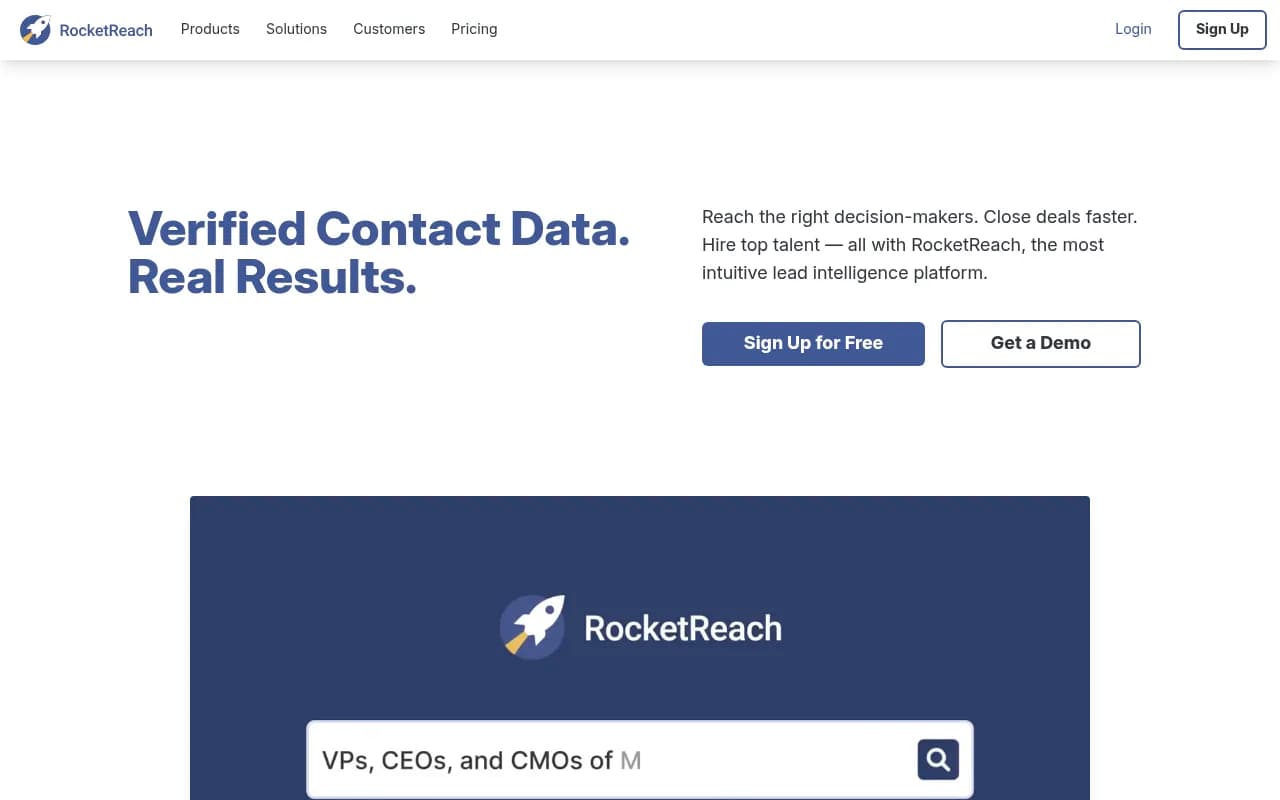
B2B contact search platform covering emails and direct dials, with native integrations for Salesforce, HubSpot, Outreach, and SalesLoft.
Key takeaways
- RocketReach covers 700M+ professional profiles and 60M companies, with claimed 90-98% deliverability on verified emails -- one of the broader databases in the B2B contact space
- Native integrations with Salesforce, HubSpot, Outreach, and SalesLoft make it easy to push contacts directly into existing sales workflows
- The platform has expanded beyond contact lookup into outreach automation (Autopilot), AI-assisted messaging, and intent data -- making it more of a full prospecting suite than a simple email finder
- Pricing starts at $6K annually for team plans, which puts it above entry-level tools like Hunter.io but below ZoomInfo's typical contract sizes
- A free tier exists but is limited; serious prospecting requires a paid plan
- Trusted by 95% of S&P 500 companies according to RocketReach, and rated G2 Leader for Spring 2026
RocketReach launched as a straightforward contact lookup tool -- you search for a person, it returns their email and phone number. That core use case still works well, but the platform has grown considerably. Today it sits somewhere between a pure data provider like Clearbit and a full sales engagement platform like Outreach. The database covers 700 million professional profiles and 60 million companies, with particular depth in healthcare, legal, technology, and founder communities. The company claims 90-98% deliverability on verified emails, which is a meaningful claim in a space where bad data wastes enormous amounts of sales time.
The target audience is broad: SDRs and AEs doing outbound prospecting, recruiters sourcing candidates, PR professionals finding journalist contacts, and marketing teams building targeted lists. RocketReach has positioned itself as a more accessible, less enterprise-heavy alternative to ZoomInfo -- and based on G2 reviews, that positioning resonates with mid-market buyers who find ZoomInfo's pricing and contract structure difficult to justify.
Key features
Contact database and search
The core product is a searchable database of 700M+ professional profiles. You can filter by job title, company, industry, location, seniority level, and more. The search returns email addresses (professional and personal), direct dial phone numbers, and social media profiles. What separates RocketReach from cheaper alternatives is the depth of filtering -- you can get genuinely specific, like finding product managers in Seattle who attended a particular university, as one testimonial on the site describes. The database has particular strength in healthcare and legal verticals, which are notoriously hard to cover well.
- Filters include: job title, company size, industry, geography, seniority, department
- Returns professional emails, personal emails, direct dials, and social profiles
- 90-98% deliverability claimed on verified contacts
- Coverage spans 60M companies globally
Browser extension
The Chrome extension lets you surface contact information while browsing LinkedIn profiles, company websites, or anywhere else on the web. This is a standard feature in the contact intelligence space, but RocketReach's extension has 300K+ users according to their Chrome Store listing, which suggests it's genuinely useful in practice. The extension pulls data in real time without requiring you to switch tabs or manually search the platform.
Autopilot (workflow automation)
This is one of the newer additions and represents RocketReach's push into automation. Autopilot lets you build workflows that automatically discover prospects matching your criteria and add them to outreach sequences. It's not as sophisticated as a dedicated sales engagement platform, but for teams that want to consolidate tools, it removes the need for a separate workflow layer.
Messages and AI writing
The Messages feature lets you send emails directly from RocketReach without exporting to another tool. The AI writer helps draft outreach messages and follow-ups. The quality of AI-generated outreach varies across tools in this category, and RocketReach's implementation appears to be table-stakes rather than a differentiator -- it generates personalized first lines and follow-up sequences, but serious sales teams will likely still customize heavily.
Intent data and technographics
RocketReach includes B2B intent data and technographic signals to help prioritize outreach. Intent data shows which companies are actively researching topics relevant to your product. Technographics reveal what software a company uses, which is useful for competitive displacement plays or integration-focused selling. These signals are available as filters when building prospect lists, letting you focus on accounts that are more likely to be in-market.
CRM and platform integrations
Native integrations with Salesforce, HubSpot, Outreach, and SalesLoft cover the most common sales tech stacks. You can push contacts directly from RocketReach into these platforms without CSV exports. The integrations handle deduplication and field mapping, which saves meaningful time when prospecting at scale.
Contact Data API
The API covers 4.5 billion records and is designed for teams that want to enrich their own databases or build contact lookup into custom workflows. The fill rate is described as "exceptional," though independent benchmarks on this are limited. The API is relevant for RevOps teams, data engineers, and companies building their own sales tools on top of RocketReach's data.
AI-powered recommendations
RocketReach surfaces lookalike prospect recommendations based on your existing contacts and search history. This is useful for expanding into adjacent accounts or finding more contacts at companies you're already targeting. The recommendations engine appears to use job title similarity, company attributes, and engagement patterns to suggest new prospects.
Who is it for
The clearest fit is outbound sales teams at B2B companies, particularly those in the 20-500 employee range where ZoomInfo's pricing is hard to justify but basic tools like Hunter.io don't provide enough depth. An SDR team running 50-200 outbound sequences per week will get real value from the combination of verified contact data, intent signals, and direct CRM integration. The ability to filter by technographics is especially useful for SaaS companies doing competitive displacement or integration-led growth.
Recruiters are a significant secondary audience. The depth of coverage in healthcare and legal makes RocketReach useful for executive search and specialized recruiting where LinkedIn Recruiter's data is thin or expensive. A recruiter sourcing biotech executives or healthcare administrators will find RocketReach's vertical-specific coverage genuinely useful.
PR and communications professionals use RocketReach to find journalist and editor contact information -- a use case that most B2B contact tools handle poorly. The platform's broad coverage of media and communications professionals makes it a reasonable choice here, though dedicated PR tools like Muck Rack have deeper editorial data.
Who should probably look elsewhere: very small teams or solo operators who only need a handful of lookups per month (the free tier covers this, but the paid plans are priced for teams). Companies doing purely inbound marketing with no outbound motion won't get much value. And enterprise sales teams with complex account-based marketing needs may find the intent data and account intelligence thinner than what Demandbase or 6sense provide.
Integrations and ecosystem
RocketReach's integration story is one of its stronger selling points. Native integrations include:
- Salesforce: Bi-directional sync, contact enrichment, deduplication
- HubSpot: Push contacts and companies directly into HubSpot CRM
- Outreach: Add prospects to sequences without leaving RocketReach
- SalesLoft: Similar to Outreach integration -- direct sequence enrollment
- Zapier: Connects RocketReach to hundreds of other tools for custom workflows
- Chrome extension: Works across LinkedIn, company websites, and the broader web
The Contact Data API is available for custom integrations and data enrichment pipelines. Documentation quality and developer experience aren't extensively detailed on the public site, but the 4.5B record coverage suggests it's built for production use cases, not just experimentation.
There's no mention of a dedicated mobile app, which is a gap for recruiters or sales reps who prospect on the go. The browser extension partially fills this gap on desktop.
Pricing and value
RocketReach's pricing structure has two main tiers: individual plans and team plans. Team plans start at $6,000 annually based on the pricing search results, which works out to $500/month. Individual plans appear to be available at lower price points, though exact monthly figures aren't prominently displayed on the site (a common tactic in this category to push demo requests).
A free tier exists and allows a limited number of lookups -- useful for evaluating data quality before committing. Monthly subscription options are available but cost more than annual plans, as is standard.
Compared to ZoomInfo, which typically runs $15,000-$40,000+ annually for team plans, RocketReach is meaningfully cheaper. Compared to Apollo.io, which has a generous free tier and paid plans starting around $49/month per user, RocketReach's team pricing is higher but the data quality and coverage claims are stronger. Hunter.io is cheaper still but covers only email addresses with no phone data or intent signals.
For a mid-market sales team of 5-10 SDRs, RocketReach's pricing is competitive if the data quality holds up. The ROI math is straightforward: if verified contact data saves each SDR 30 minutes per day of manual research, the tool pays for itself quickly.
Strengths and limitations
What it does well:
- Database breadth: 700M profiles is genuinely large, and the vertical depth in healthcare and legal is a real differentiator. Most competitors have thinner coverage in these industries.
- Data accuracy: The 90-98% deliverability claim on verified emails, if accurate, is above industry average. Bad email data is a major pain point in outbound sales, and RocketReach's verification layer appears to be a real investment.
- CRM integrations: The native integrations with Salesforce, HubSpot, Outreach, and SalesLoft are well-implemented and cover the most common sales tech stacks. This reduces friction significantly compared to tools that require CSV exports.
- Ease of use: Multiple G2 reviews and the platform's own awards (G2 Most Implementable, Easiest Admin) suggest the UX is genuinely accessible. This matters for teams that don't have dedicated RevOps support.
- Breadth of use cases: The combination of sales prospecting, recruiting, and PR use cases means the tool can serve multiple teams within a company, improving the cost-per-user math.
Limitations:
- Pricing transparency: Like most tools in this category, RocketReach doesn't publish granular pricing on its website. The "talk to sales" model for team plans is frustrating for buyers who want to self-serve.
- Intent data depth: The intent data and technographic signals are useful but appear to be thinner than dedicated ABM platforms like 6sense or Demandbase. For account-based marketing programs that rely heavily on intent signals, this may be a gap.
- Outreach features are secondary: The Messages and Autopilot features are functional but not best-in-class. Teams with serious outbound volume will likely still want a dedicated sales engagement platform like Outreach or Salesloft alongside RocketReach, rather than replacing them with it.
- No mobile app: For a tool used by salespeople and recruiters who work on the go, the absence of a mobile app is a real gap.
Bottom line
RocketReach is a solid choice for B2B sales teams, recruiters, and PR professionals who need broad, accurate contact data with minimal friction to get it into their existing tools. The combination of 700M+ profiles, strong CRM integrations, and a more accessible price point than ZoomInfo makes it a practical option for mid-market companies running outbound programs.
Best use case in one sentence: a 5-15 person SDR team at a B2B SaaS or services company that needs verified email and phone data with direct Salesforce or HubSpot integration, without paying ZoomInfo prices.
Tags:
Frequently asked questions
What is RocketReach?
Is there a free plan?
How much does RocketReach cost?
How does RocketReach compare to ZoomInfo?
What CRM integrations does RocketReach support?
Who is RocketReach best suited for?
Similar and alternative tools to RocketReach