Key takeaways
- Most traditional SEO tools added AI search features in 2026, but the majority are surface-level additions -- basic mention tracking with no path to improvement.
- The tools that actually deliver combine monitoring with content optimization and actionable gap analysis, not just dashboards showing you where you're invisible.
- Ahrefs and Semrush have the most credible AI search additions among legacy platforms, but both still lag purpose-built GEO tools on depth and actionability.
- Surfer SEO and Clearscope remain strong for on-page optimization but don't meaningfully address AI search visibility.
- If AI search visibility is a real priority (and in 2026, it should be), you'll likely need a dedicated platform alongside your existing SEO stack.
Every SEO tool vendor had the same pitch in 2026: "We now track AI search." The emails landed in inboxes, the blog posts went up, the webinars ran. And to be fair, the pressure was real -- ChatGPT, Perplexity, Google AI Overviews, and a dozen other AI engines are now answering questions that used to send people to Google's blue links. Brands that don't show up in those answers are losing visibility they can't even measure.
So the tools responded. But "responding" covered a huge range -- from genuinely useful new capabilities to a renamed dashboard and a press release. This guide goes through 10 of the most-discussed SEO tools that added AI search features this year, and gives you an honest read on whether the additions are worth your time.
1. Semrush
Semrush is the tool most marketing teams already have open in a browser tab. Its AI search additions in 2026 are real -- there's a dedicated AI Overviews tracking module, brand mention monitoring across several LLMs, and integration with its existing content workflow tools.
The honest limitation: Semrush uses fixed prompt sets. You're tracking visibility for the prompts Semrush chose, not the prompts your actual customers are typing. That's a meaningful gap. If your category has unusual or long-tail query patterns, you might be optimizing for the wrong questions entirely.
Still, for teams already deep in the Semrush ecosystem, the AI additions are a reasonable starting point. Just don't mistake "starting point" for "complete solution."
2. Ahrefs
Ahrefs launched Brand Radar, its AI search visibility feature, and it's one of the more credible additions from a legacy SEO platform. The data quality is solid, the interface is familiar, and it fits naturally into how SEO teams already use Ahrefs for keyword research and backlink analysis.
The gaps are similar to Semrush: fixed prompts, no AI traffic attribution, and no content generation to help you act on what you find. Tim Soulo, Ahrefs' CMO, wrote a detailed breakdown of the AI SEO tool landscape in February 2026 that's worth reading -- notably, even he frames Ahrefs' AI search features as one piece of a larger picture rather than a complete solution.
For teams that live in Ahrefs, Brand Radar is worth turning on. But it's a monitoring layer, not an optimization engine.
3. Surfer SEO
Surfer SEO is still the go-to for on-page content optimization, and that hasn't changed in 2026. Its Content Score system, NLP-based keyword suggestions, and integration with Google Docs make it genuinely useful for writing content that ranks in traditional search.
The AI search angle is thinner. Surfer has added some features around optimizing for AI-friendly content structures -- clear headings, direct answers, FAQ sections -- but it doesn't track whether your content is actually being cited by ChatGPT or Perplexity. It helps you write better content; it doesn't tell you if AI engines are reading it.
That's not a knock on Surfer. It's just a different tool for a different job. If you're using it for Google SEO and hoping the AI search piece will sort itself out, you're probably right that good content helps. But you're flying blind on the AI side.
4. Clearscope
Clearscope sits in the same category as Surfer -- excellent at what it does (content grading, topic coverage analysis, semantic keyword recommendations), and not really designed for AI search visibility.
The tool added some AI-assisted writing features in 2026, but nothing that meaningfully addresses the question "is my brand being cited in AI answers?" It's a content quality tool, and a good one. Teams using it for traditional SEO content workflows should keep using it. Teams hoping it solves their AI visibility problem should look elsewhere.

5. SE Ranking
SE Ranking has been quietly building out its AI search features more aggressively than most mid-market SEO platforms. It now includes AI Overview tracking, some LLM mention monitoring, and a content editor that's been updated to account for AI-friendly formatting.
The platform also launched SE Visible as a standalone AI visibility product. The tracking is functional -- you can see where your brand appears in AI answers -- but the actionability is limited. There's no content gap analysis, no way to generate content based on what you find, and no crawler log data to understand how AI engines are interacting with your site.
SE Ranking is a solid all-in-one SEO platform. Its AI additions are better than average for the price point. But "better than average" still means you're mostly looking at a monitoring dashboard.
6. Moz
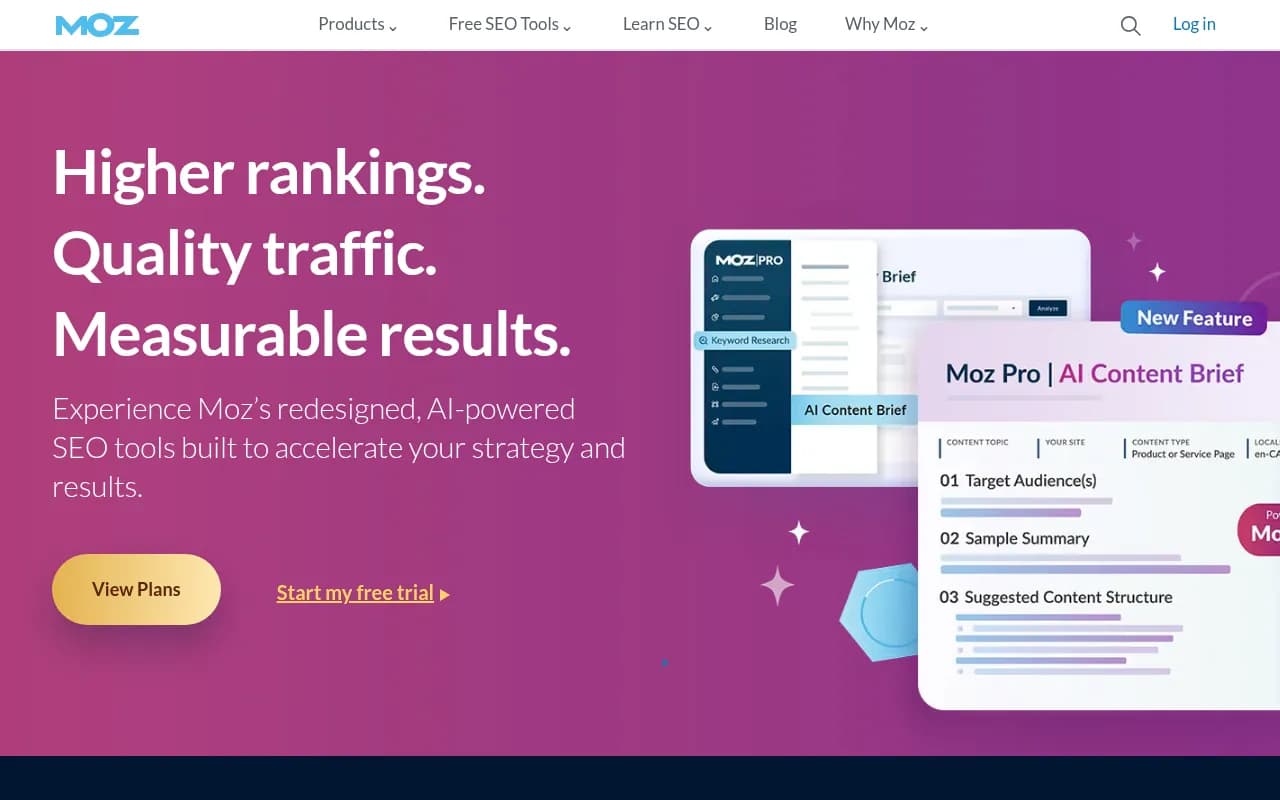
Moz's AI search additions in 2026 have been modest. The platform added some AI Overview visibility tracking and updated its content analysis tools to flag AI-readability issues, but it hasn't made AI search a core part of its product direction the way some competitors have.
For teams that use Moz primarily for domain authority tracking, link research, and local SEO, this probably doesn't matter much. The core Moz Pro features are still strong. But if you came to Moz hoping for a serious AI search solution, you'll be disappointed.
7. Frase
Frase is interesting because it was already more content-research-focused than most SEO tools, and that foundation translates reasonably well to AI search optimization. The tool helps you understand what questions people are asking, what content currently ranks for those questions, and how to structure answers that are comprehensive and direct.
That's actually a decent proxy for what AI engines want -- they tend to cite content that directly and clearly answers a question. Frase doesn't track AI citations explicitly, but the content it helps you produce is more likely to earn them.
It's not an AI search tool in the monitoring sense. But it's a useful content research tool that happens to produce AI-friendly output.
8. MarketMuse
MarketMuse has leaned into content strategy and topical authority, which is genuinely relevant to AI search. AI engines tend to cite sources that demonstrate depth and authority on a topic, not just individual pages that match a query. MarketMuse's content planning features -- topic modeling, content gap analysis, competitive content scoring -- help you build that kind of authority systematically.
Like Frase, it's not tracking AI citations directly. But the strategic layer it provides is more aligned with AI search success than tools that just optimize individual pages.
9. AccuRanker
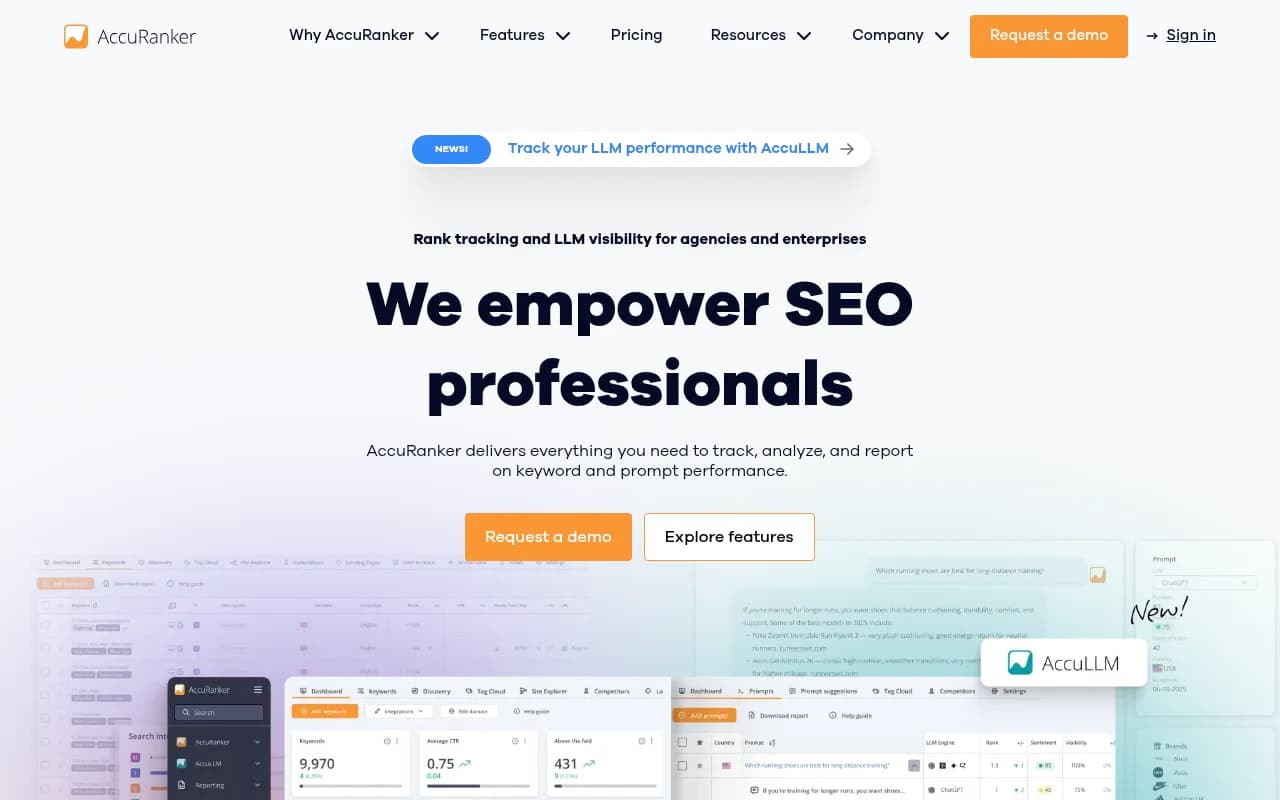
AccuRanker added AI search tracking in 2026, and it's a reasonable addition to a tool that's always been strong on rank tracking speed and accuracy. The AI visibility features are basic -- brand mention monitoring, some LLM coverage -- but they're integrated cleanly into the existing interface.
For agencies that already use AccuRanker for client rank tracking, the AI additions give you something to show clients without switching platforms. That has real value. Just be clear with clients about what "AI visibility" means in this context -- it's a monitoring metric, not an optimization outcome.
10. Scalenut
Scalenut has been building out its AI content features aggressively, and in 2026 it added AI search visibility tracking alongside its existing content creation and optimization tools. The combination is more interesting than most -- you can identify content gaps, generate content to fill them, and track how your visibility changes.
The execution is still maturing. The AI search tracking is less sophisticated than dedicated GEO platforms, and the content generation quality is variable. But the direction is right: Scalenut is at least trying to close the loop between monitoring and action, which most tools aren't.
How these tools actually compare
Here's an honest side-by-side of what each tool actually delivers on the AI search front:
| Tool | AI mention tracking | Content optimization | Gap analysis | Content generation | Crawler/traffic data |
|---|---|---|---|---|---|
| Semrush | Yes (fixed prompts) | Yes | Limited | Via ContentShake | No |
| Ahrefs | Yes (Brand Radar) | Yes | No | No | No |
| Surfer SEO | No | Yes | No | Yes | No |
| Clearscope | No | Yes | No | No | No |
| SE Ranking | Yes | Yes | No | Limited | No |
| Moz | Limited | Yes | No | No | No |
| Frase | No | Yes | Partial | Yes | No |
| MarketMuse | No | Yes | Yes | Yes | No |
| AccuRanker | Yes | No | No | No | No |
| Scalenut | Yes | Yes | Partial | Yes | No |
The pattern is obvious: most tools can show you some version of where you appear (or don't appear) in AI answers, but almost none of them help you do anything about it. The monitoring-to-action gap is the real problem with this entire category.
What's actually missing from all of them
The tools above are all doing something useful. But there's a consistent gap across the board: they show you data without giving you a clear path to improving it.
The specific things that are missing:
Real prompt data. Most tools track AI visibility using their own fixed prompt sets. That means you're measuring visibility for the questions the tool vendor chose, not the questions your customers are actually asking. Prompt volume estimates, difficulty scores, and query fan-outs -- the things that help you prioritize which gaps to close first -- are absent from most of these platforms.
Crawler log data. Knowing that ChatGPT or Perplexity crawled your site, which pages they read, how often they return, and whether those crawls led to citations is genuinely useful. None of the tools above offer this. You can't fix indexing problems you can't see.
Content generation grounded in AI data. Several tools generate content, but it's generic SEO content. Content that's actually engineered to fill specific AI citation gaps -- built from real prompt data, competitor citation analysis, and brand guidance -- is a different thing entirely.
Traffic attribution. Connecting AI visibility to actual website traffic and revenue is the question every marketing team eventually asks. Most tools don't answer it.
The case for a dedicated GEO platform
If AI search visibility is a real priority -- and for most brands in 2026, it should be -- the honest answer is that the AI features bolted onto traditional SEO tools probably aren't enough on their own.
Purpose-built platforms like Promptwatch are designed around the full loop: find the gaps (which prompts are competitors visible for that you're not?), create content that fills those gaps (using real prompt data, citation analysis, and brand guidance), and track the results (page-level citation tracking, crawler logs, traffic attribution).

That's a different architecture than "we added an AI tab to our rank tracker." The distinction matters when you're trying to actually improve your AI visibility, not just measure it.
Other dedicated tools worth knowing about:
- AthenaHQ -- solid monitoring, less actionable on the content side
- Otterly.AI -- good for basic brand mention tracking across ChatGPT and Perplexity
- Profound -- strong enterprise feature set, higher price point
- AirOps -- interesting for content engineering workflows

Otterly.AI

Profound

The bottom line
The SEO tool market's response to AI search in 2026 has been predictable: add monitoring features, ship a blog post, update the pricing page. A few tools -- Semrush, Ahrefs, Scalenut -- have made genuinely useful additions. Most have added a dashboard that shows you a problem without helping you solve it.
That's not entirely cynical. Monitoring is a real first step. Knowing you're invisible in AI answers is better than not knowing. But if you stop at monitoring, you're just watching competitors get cited while you wait.
The teams getting real results from AI search in 2026 are the ones who've closed the loop: they know which prompts matter, they know what content is missing, they create that content, and they track whether it works. The tools that support that full cycle are worth paying for. The ones that just show you a red dashboard are not.
Use your existing SEO stack for what it's good at. Add a dedicated AI visibility platform if AI search is a meaningful channel for your business. And be skeptical of any vendor claiming their bolt-on AI tab is a complete solution -- it almost certainly isn't.