Key takeaways
- Botify's strength is real server log ingestion at enterprise scale. It publishes no prices, and Vendr puts the median contract at $74,200 a year, per Orchly's comparison.
- For classic crawl budget analysis at scale, JetOctopus and Oncrawl are the closest substitutes. Screaming Frog's Log File Analyser covers small and mid-sized sites.
- If your real question is "are GPTBot, ClaudeBot and PerplexityBot reading my pages, and do they cite them?", you want AI-crawler-specific tooling with IP verification, not a general log analyzer.
- Spoofed user agents are common. Any tool you pick should verify bots against published IP ranges.
- Many teams will end up with two tools: one for Googlebot and crawl budget, one for AI crawlers and citations.
Why people look for Botify alternatives
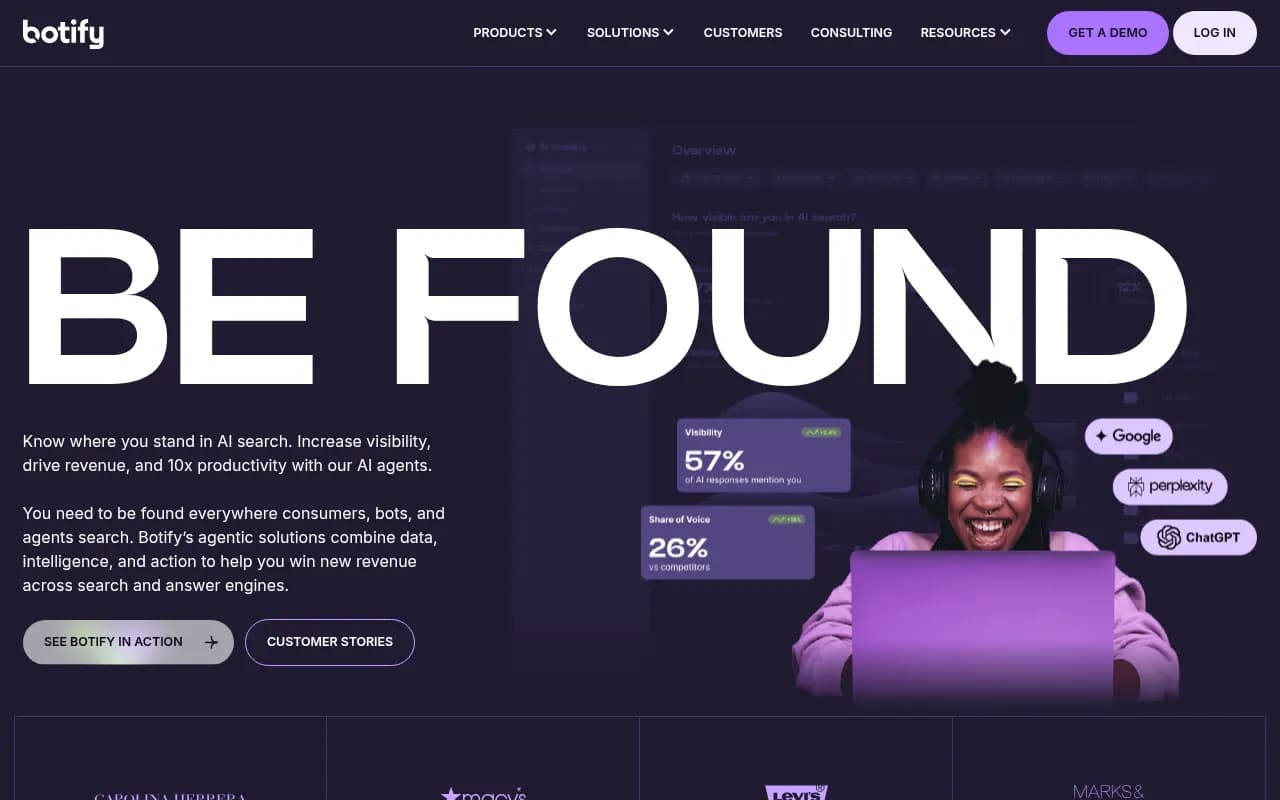
Botify is good at what it does. It crawls very large sites, ingests server logs, and since April 2026 LogAnalyzer tracks Claude-User, Claude-SearchBot and Google-Agent alongside the older bots. Nobody serious disputes that.
The complaints are usually about three things. Price, mostly. The lack of public pricing, so you can't budget without a sales call. And fit: a lot of teams bought enterprise log analysis for a site where a desktop tool and a few hours a month would have done the job.
There's a fourth reason that's newer. The question changed. A few years ago, log analysis meant crawl budget and Googlebot. Now people want to know which AI crawlers visit, what they read, and whether any of it turns into citations. That is a different workflow, and not every log tool was built for it.
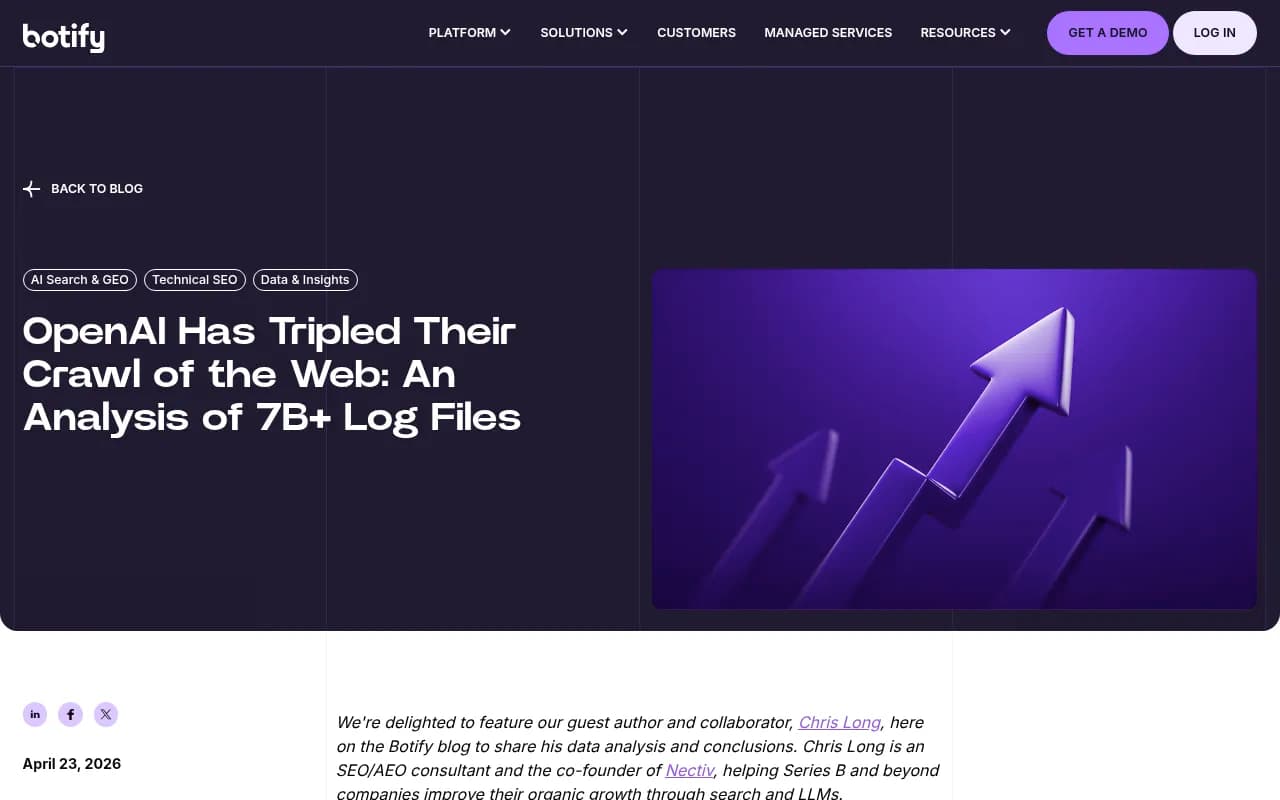
Botify itself published an analysis of roughly 7 billion log files (November 2024 through March 2026) covering OpenAI's three bots: ChatGPT-User, GPTBot and OAI-SearchBot. Its headline is that OpenAI's crawl has tripled. It's a good example of why log data matters now, and also a reminder that you can only see this on your own site if you're collecting the logs.
What AI crawler log analysis needs to do
Before comparing tools, it helps to be clear about the job. A log analyzer that is useful for AI crawlers should:
- Identify the major bots by user agent. At minimum: GPTBot, OAI-SearchBot, ChatGPT-User, ClaudeBot, Claude-User, Claude-SearchBot, PerplexityBot, Perplexity-User, Google-Extended, Google-Agent, MistralAI-User, and the Meta agents (meta-webindexer, meta-externalagent, meta-externalfetcher).
- Verify those bots by IP, not just user agent. Putting GPTBot in a header takes one line of code and scrapers do it routinely.
- Separate training, search and answer-time fetches. These behave differently and mean different things for you.
- Show per-path and per-section crawl frequency, plus errors.
- Ideally connect crawl activity to citations and traffic, so you can see whether being read leads to being cited.
The Meta point is worth dwelling on. According to Promptwatch Data's Meta-WebIndexer report, Meta-WebIndexer went from about 2.2% of tracked AI crawler requests in mid-July 2026 to 37.8% on August 9, which made it the heaviest AI crawler in their logs. If your filters only list OpenAI and Anthropic, you'd have missed that entirely, and if your infrastructure bills by request, you'd have felt it.
The overall mix shifts too. In Promptwatch's AI crawler traffic report (IP-verified requests, June 8 to September 6, 2026), OpenAI's share of verified AI crawler requests fell from 94.8% to 79.8%. Shares aren't absolute volumes, but the direction is clear: the field is getting less OpenAI-dominated. Compare your own logs to that mix. If a provider is big overall and near zero in your logs, you're probably blocked from it by robots.txt, a CDN rule or a WAF.
Botify alternatives compared
| Tool | Best for | Log analysis | AI crawler focus | Pricing |
|---|---|---|---|---|
| JetOctopus | Large sites wanting Botify-style depth for less | Yes, at scale | Some | Published, generally cheaper than Botify |
| Oncrawl | Teams with analysts who want to query data | Yes | Some | Custom |
| Lumar | Enterprise technical SEO and site health | Limited vs Botify | Growing | Custom |
| seoClarity | Enterprise workflow plus some log data | Yes, less deep | Some | Custom |
| Conductor | Enterprise content and SEO coordination | Limited | Some | Custom |
| Screaming Frog Log File Analyser | Small and mid-sized sites | Yes, desktop | Manual (filter by UA) | Low annual license |
| Sitebulb | Technical audits | Light | No | Low |
| Promptwatch | AI crawler logs tied to citations and traffic | IP-verified AI bot logs | Core feature | From $95/mo |
| Siteline AI | AI agent traffic analytics | Agent traffic | Core feature | Check vendor |
Prices change, so confirm on each vendor's site.
Enterprise log analysis alternatives
This group is for sites with millions of URLs where the logs themselves are huge.
JetOctopus
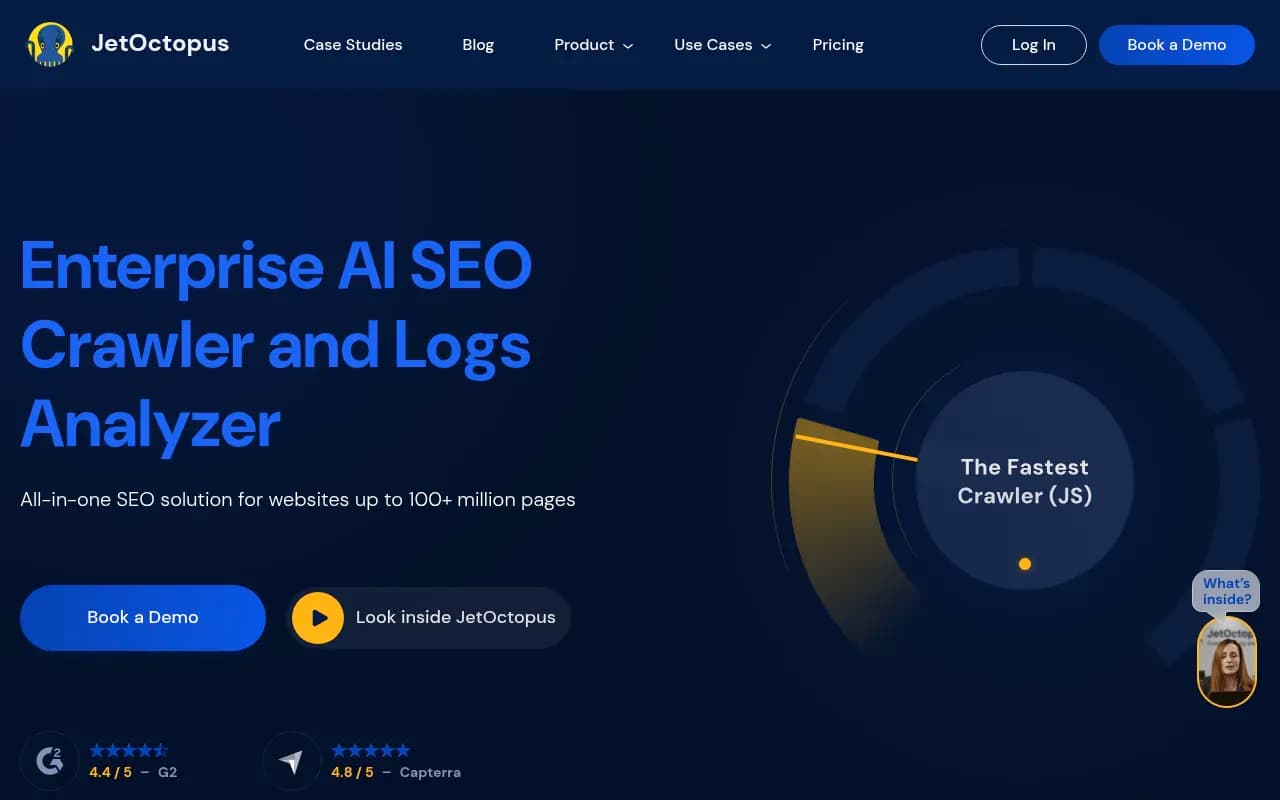
JetOctopus is the alternative most people reach for first. It pairs a crawler with log analysis at large scale, and it's generally cheaper than Botify while aiming at the same technical audience. If your reason for leaving Botify is price rather than capability, start here.
Oncrawl
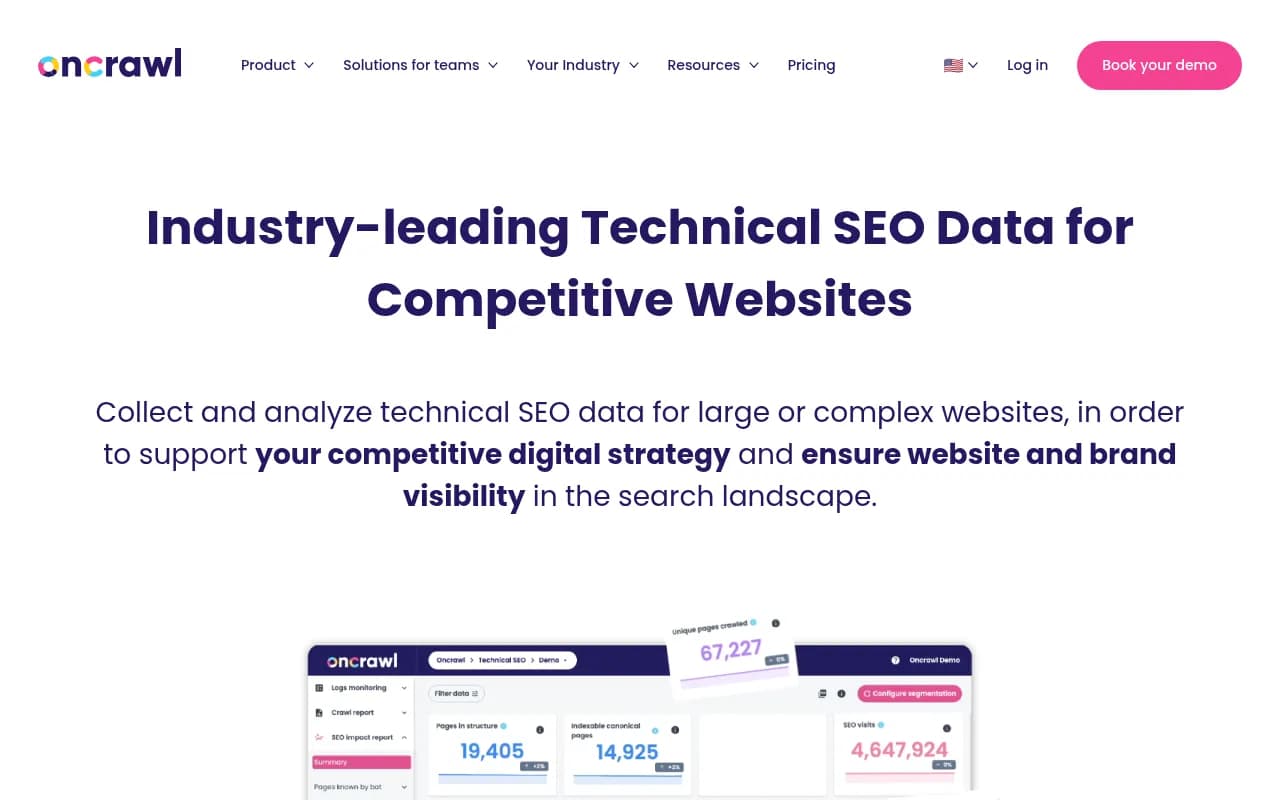
Oncrawl leans toward data science. You can run custom analysis, join crawl and log data, and pipe it elsewhere. It suits teams with an analyst who wants to query the data rather than click through prebuilt reports. If nobody on your team will ever write a query, you're paying for flexibility you won't use.
Lumar
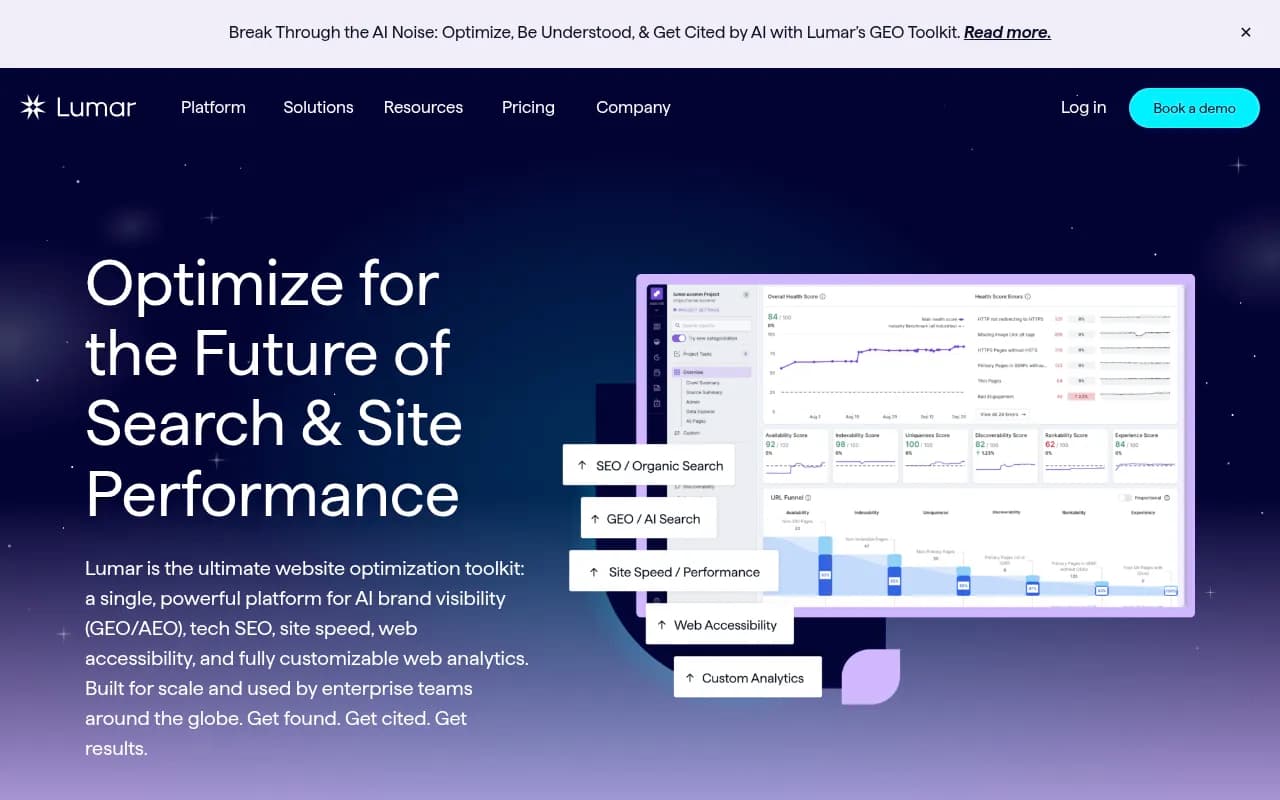
Lumar is an enterprise optimization platform, strong on site health and technical monitoring. It's a better fit when you need ongoing governance across many teams than when you need to dig through raw logs.
seoClarity and Conductor
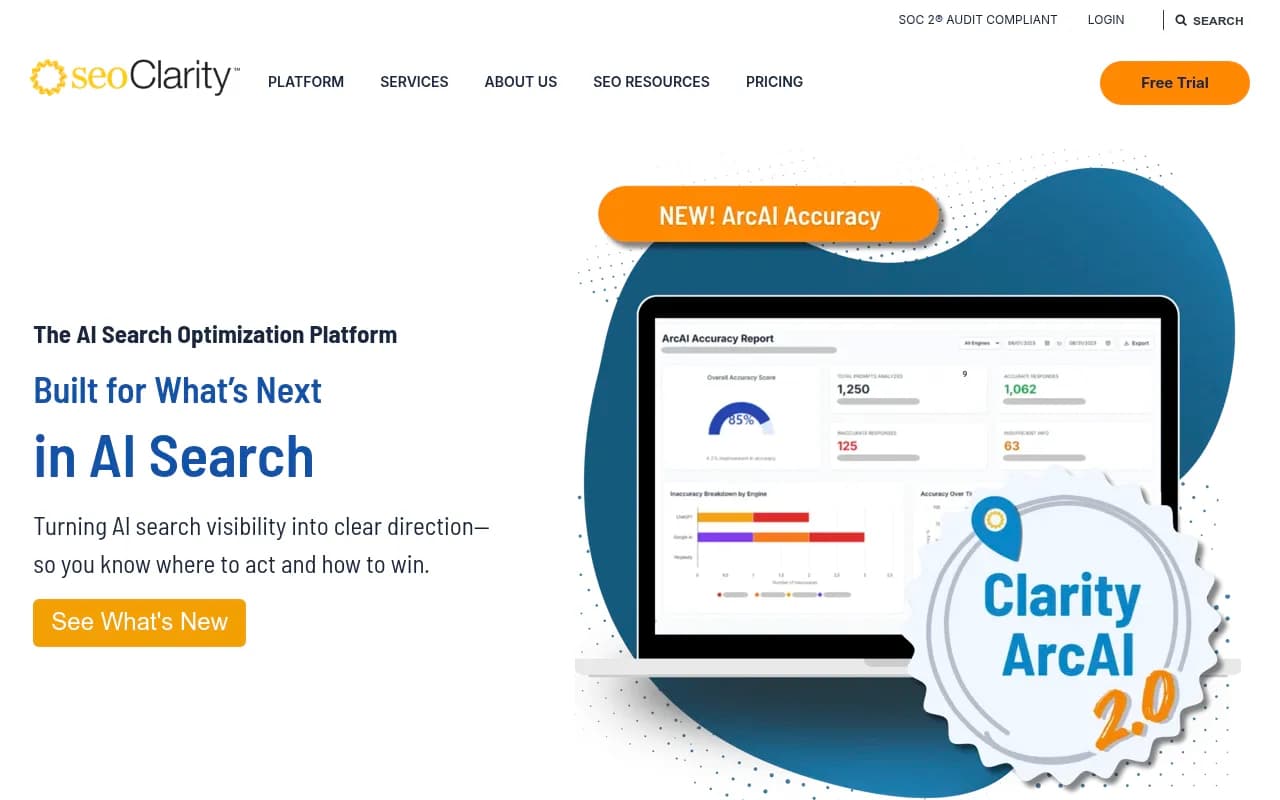
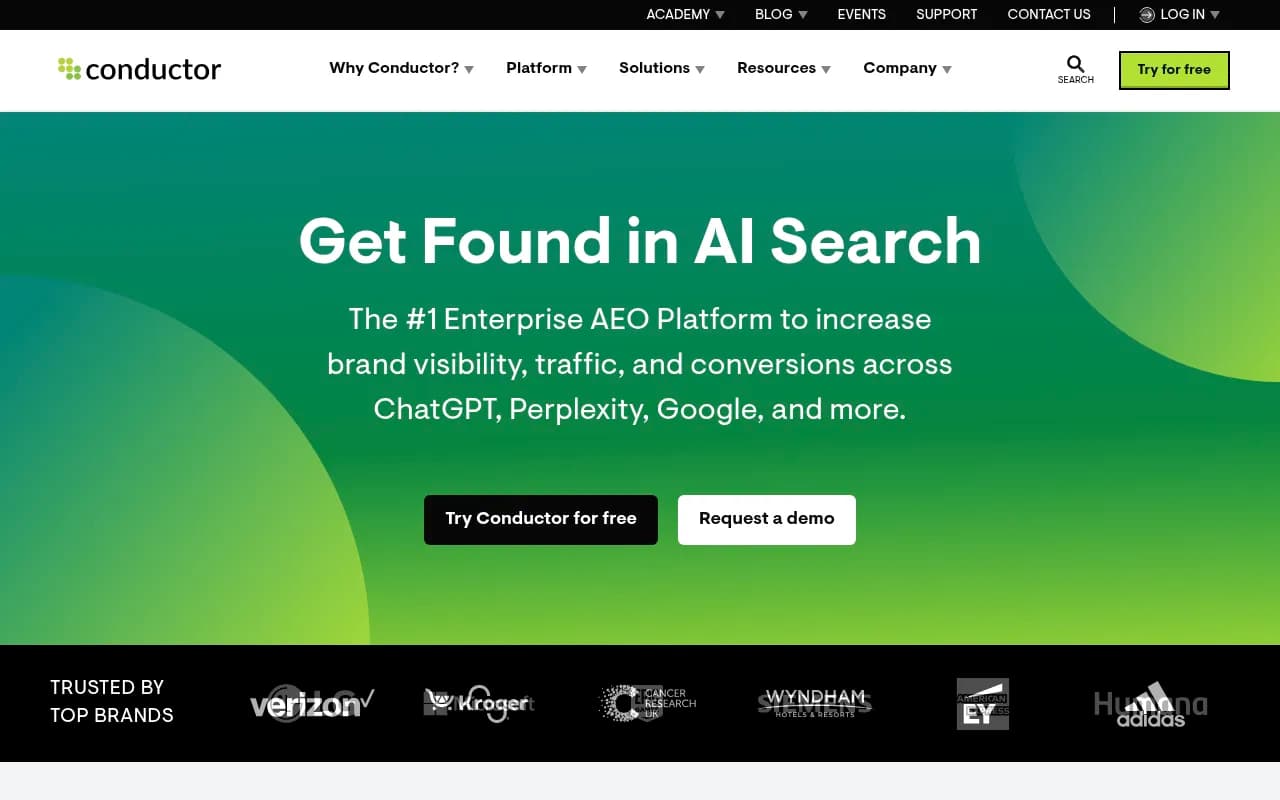
Both are enterprise SEO platforms with log capabilities sitting alongside a broader workflow. The tradeoff is simple: less depth on logs than Botify, more on coordination, reporting and content. They make sense if workflow matters as much as crawl data.
Desktop and lightweight options
Here's my honest opinion: a lot of teams buy enterprise log analysis for a site where a desktop tool and a few hours a month would do. The enterprise case is real above a certain URL count and rarely below it.
Screaming Frog Log File Analyser
You import log files, and it shows which bots hit which URLs, with response codes and frequency. It's manual and it won't cope with hundreds of millions of lines, but for most sites it's enough. You can filter by user agent to isolate GPTBot or ClaudeBot, though IP verification is on you.
Sitebulb
Sitebulb is a strong desktop crawler with clear audit reporting. It's lighter on log analysis than Screaming Frog's dedicated tool, so pick it for audits rather than bot behavior.

AI-crawler-first tools
This is where the newer question gets answered. These tools care less about Googlebot crawl budget and more about which AI systems read your site, what they hit, and what happens next.
Promptwatch
Promptwatch is the one I'd point most teams to if AI crawlers are the main reason for looking at logs. Its crawler logs are IP-verified, so spoofed bots are filtered out, and they cover GPTBot, OAI-SearchBot, ChatGPT-User, ClaudeBot, Claude-User, Claude-SearchBot, PerplexityBot, Perplexity-User, Google-Agent, Meta-WebIndexer, Meta-ExternalAgent, MistralAI-User and others. You see which pages each crawler read, the errors they hit (with plain-language explanations of crawl failures), and a crawl-to-citation path with a citation rate per page.
That last part is what a traditional log analyzer can't give you. Knowing GPTBot fetched a page is half the story. Knowing whether that page then got cited, and whether anyone clicked through, is the useful half.
Ingestion works through Cloudflare, AWS CloudFront, Fastly, Vercel, Netlify, Akamai, Google Cloud CDN, a custom HTTP endpoint, or a WordPress plugin. It also layers in visitor analytics for AI-referred traffic, weekly site audits, and Search Console and Bing data per page, so you can ask things like which pages rank in Google but never get cited by AI. If you want to act on what you find, its Content Agent and Action Board turn gaps into work.
It isn't a replacement for Botify's deep crawl budget analysis on a ten-million-URL site. Think of it as the AI side of the problem, done well. Plans start at $95/month (Essential), with Professional at $245 and Business at $579; confirm on promptwatch.com/pricing.

Siteline AI and other agent-traffic tools
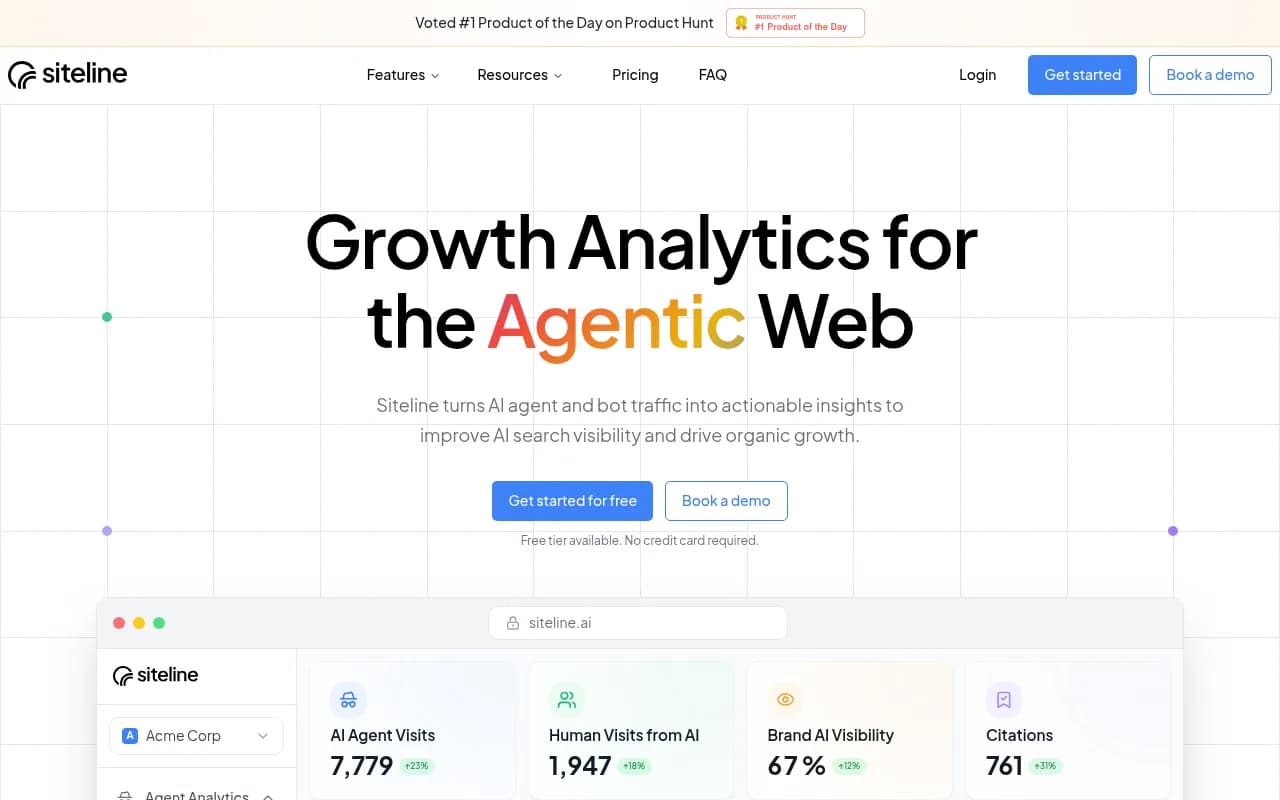
Siteline AI focuses on AI agent traffic analytics. xSeek pairs ChatGPT rank tracking with GPTBot monitoring, and Scriptbee offers unlimited domains with AI crawler monitoring. These are narrower than a full platform, but they're cheap ways to start seeing AI bot activity.
Kitbase
Kitbase, which published a comparison of Botify alternatives, forwards requests from your server or edge, resolves each to a named crawler, and verifies it against the crawler's published identity before counting it. It has forwarders for Next.js, Vercel, nginx and Cloudflare Workers. Note it is the author of that comparison, so weigh the framing accordingly.
AI visibility platforms with a crawler angle
Some Botify alternatives are really AI visibility platforms that happen to include bot analytics. Orchly, for example, offers AI search tracking, Google data, AI crawler analytics and a Site Health Agent starting at $49/month. Note that Orchly publishes the "11 best Botify alternatives" list and says it hasn't used Botify, so treat its descriptions of Botify as secondhand.
Most monitoring-only trackers (Otterly, Peec and similar) show you whether your brand is mentioned but have no crawler logs at all. If logs are a requirement, check that before you buy. For a wider look at the category, the GEO software directory lists options side by side.
How to choose
If your site has millions of URLs and Googlebot is the priority
Stay with Botify or move to JetOctopus or Oncrawl. Request quotes from all three and compare against the same log volume.
If your site is small to mid-sized
Screaming Frog's Log File Analyser plus a few hours a month will probably do. Don't pay enterprise prices for a problem a desktop tool solves.
If the real question is AI visibility
Use an AI-crawler-first tool. You need IP verification, a current bot list, and a link between crawling and citations. A general log analyzer that doesn't know about meta-webindexer or Claude-SearchBot will leave gaps.
If you want both
This is common and perfectly reasonable. Keep a crawl-budget tool for Google and add an AI crawler tool alongside it. They answer different questions.
Practical checklist for AI bot log analysis
Whatever you choose, run through this:
- Confirm robots.txt, CDN and WAF rules aren't accidentally blocking GPTBot, OAI-SearchBot, ClaudeBot or PerplexityBot. Check every provider, not just OpenAI.
- Split by crawler, not just by company. Training, search and answer-time fetch traffic are different things. A ChatGPT-User hit means someone asked a question that touched your page.
- Verify by IP. Count only requests whose source IP matches the operator's published ranges.
- Watch for sudden shifts. Meta's surge is the recent example; set alerts on any one agent's share of requests.
- Look at errors per bot. A 403 or timeout for one crawler and not another usually points to a WAF rule.
- Compare crawls to citations. A page crawled often but never cited is a content problem; a page never crawled is an access problem.
For background on how crawl activity relates to citations in ChatGPT, see Promptwatch's data on which content types ChatGPT cites, where product pages lead at 22.4% of citations for Sep 28 to Oct 4, 2026. And if you're hiring help to interpret all of this, 1001 SEO Media works on technical SEO and AI search visibility.
Bottom line
Botify is still the benchmark for deep crawl and log work on very large sites. But if you're leaving for price, JetOctopus is the nearest like-for-like swap. If you're leaving because AI crawlers are now the question, pick a tool built around verified AI bot data and citation tracking, and keep a classic crawler for Google. For smaller sites, a desktop log analyzer and a bit of discipline go a long way.